What I Have Learned as a New Tactical Medic

This piece is for the medics and paramedics who are thinking about the tactical role, or who are early in their first year on a team and trying to figure out what the training did not teach them. I am a working tactical medic in my first year attached to a team. Before I took this role I had years of civilian EMS experience, TECC certification, and what I thought was a good sense of what tactical medicine would look like. The first year has taught me that what I thought I knew was partially right and partially incomplete. This piece is the incomplete part.
When I started, I thought tactical medicine was about trauma. TECC training focuses on trauma. The scenarios you run in class are trauma scenarios. The kit you build during initial training is optimized for trauma. That framing is not wrong, and TECC and TCCC, including the TECC course I took through Penn Tactical Solutions, provide the essential foundation for tactical medical care. What surprised me was how much of the day-to-day job involves skills outside those courses.
I should be honest about why I wanted the role in the first place. Tactical medicine is the cool guy thing in the industry. Everyone on the outside looking in sees the plate carriers and the mission profile and thinks that is what they want to do. I was no different.
I signed up for a job I pictured as something out of a training video. What I got, on my team, involves a lot of pre-mission paperwork, blister care, and being the guy someone asks about a suspicious mole. I was not expecting to be kicking doors. I also was not expecting to be researching pharmacy locations along the evacuation route for a dignitary visit at three in the morning. Both things are the job. One of them is on the training video. The other one is what you actually do.
Most of your job happens before the mission
The first thing new medics get wrong is thinking that the job starts when the team leaves the staging area. It does not. Most of the job happens in the days and hours before the operation, and the medics who are good at those days and hours are the ones who make everything else look easy on the day.
Pre-mission preparation for a tactical medic includes work that no TECC class taught me. Assessing the threat environment for the specific mission. Route mapping for the vehicle taking a patient to the nearest ER, and the second-nearest, and the third-nearest, because the closest one is often the wrong choice depending on the injury type.
Pulling weather reports and thinking through what the weather means for the operation and for medical risk. Inventorying the assets you have available, both on the team and in the responding EMS system. Understanding what the team needs beyond medical. Reviewing pre-existing medical issues for the team members, because the guy with the bad knee is the guy who will roll his ankle at the wrong moment and you should already know his baseline.
None of it is glamorous. Some of it is the kind of work that a new medic will resent because it feels like something a staff officer should be doing. That is the wrong way to think about it. The medic who has done the pre-mission work knows things about the operation that nobody else on the team knows. When the operational tempo starts and the plan changes, the medic who prepared is the person who can adapt.
Minor care and force preservation matter more than trauma care
The trauma dressing in your bag is important. It is also probably not the item you will use most often on a real operation. What you will actually use, over and over, is the small stuff. A bandaid with a princess on it for a hand cut. Neosporin for a scrape. Moleskin for a blister forming inside a boot. Ibuprofen for a headache. Cough drops for someone whose throat is raw from breathing dust.
My team calls the small stuff force preservation. The framing matters. Every minor issue that a medic addresses is one less reason for a team member to come off the line. A blister that gets treated at hour four does not become the reason someone limps at hour twelve. The team stays functional because someone is paying attention to the small things.
The princess bandaid story is real. I have princess bandaids in my kit. The kind you would immediately recognize, made by a major media company that I will not name here for reasons that anyone who has dealt with trademark lawyers will understand. I did not buy them for the operational role. I bought them because they were what was available when I needed to restock, and I did not check the branding before I paid.
They stayed in the kit because kids love them and adults who need a bandaid on a scene appreciate the humor. The princess bandaids get used more often than the chest seal. Build your kit for what you actually do, not just for what you trained for. If you are worried about the operator points you might lose for carrying princess bandaids, I would tell you that you have bigger problems.
Ounces equal pounds and pounds equal pain
My first tactical medic bag was heavy. I had built it based on what my TECC instructor recommended, plus everything I could think of that might be useful in a scenario I had not thought of yet. The bag was thorough. It was also thirty-five pounds of gear that I had to carry all day. A medic who is exhausted from carrying their own kit is not going to be effective when the team needs them. I looked prepared. I felt like I had been beaten with a bag of hammers.
The special operations community has a saying. Ounces equal pounds, and pounds equal pain. Every item in the bag has to justify its weight. If an item does one thing and gets used rarely, its weight is hard to justify. If an item does three things and gets used often, its weight earns its place.
My bag now weighs about eighteen pounds, and I use almost everything in it on most operations. The weight I removed was not gear that would have saved a life. It was gear that made me feel prepared for a scenario that had never happened. New medics tend to overpack because they are trying to be ready for anything. Experienced medics pack for what actually happens most of the time and trust that they can improvise for the edge cases.
Different missions require different bags. My team runs major incident response, which can mean anything from natural disasters to civil unrest to dignitary visits. Each mission type has a different medical risk profile and a different kit requirement. Trying to carry one bag that covers all three means carrying weight that is not relevant to the mission you are actually running that day.
The solution most experienced medics settle on is multiple kits organized by mission type. You keep a base kit that goes on every operation. Supplementary bags or inserts get added depending on the mission. One of the medics on my team runs a battle belt with mission-specific inserts and keeps his main bag consistent. The base capability stays constant. The mission-specific gear rotates in and out depending on what he is going to do that day.
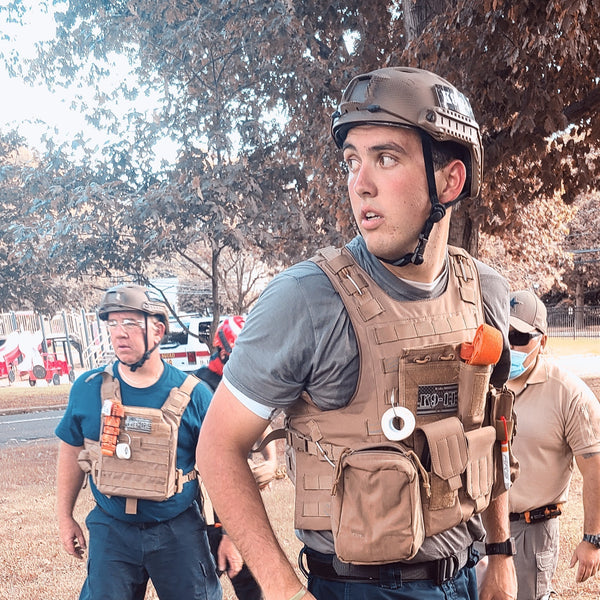
The related issue is what goes on your vest. New medics tend to load their plate carrier with every pouch and every piece of gear they can imagine needing. What actually happens is that you become slow, top-heavy, and unable to move the way the team needs you to move. As a medic, your ability to move is an asset. If you cannot get to a downed operator quickly because you are fighting your own gear, the weight you thought was preparing you actually made you worse at the job.
What belongs on your vest is what you need to access in the first thirty seconds of a medical emergency. Tourniquets. Shears. Gloves. A chest seal. Maybe a pressure dressing. A flashlight, because you cannot treat what you cannot see. Everything else belongs in your bag or in the truck. The vest is the immediate-response layer. The bag is the sustained-care layer. The truck is the resupply layer.
Address team needs, not just patient needs
Early in my first year I thought my job was to be ready for the person who got hurt. That framing is incomplete. My actual job is to keep the team functional, which sometimes means the person who got hurt but more often means everyone else.
The example I use with newer medics is dry socks in the truck. If your team has been operating in wet conditions all day and you have a bag of clean dry socks in the vehicle, you have solved a foot injury problem that has not happened yet. The team members who change socks stay functional for the rest of the operation. The team members who do not are the ones who develop trench foot, blisters, or fungal infections that put them out of service later in the week.
The dry socks example generalizes. Extra water bottles in the truck. Electrolyte packets for hot days. Hand warmers for cold days. Cough drops for dry air. Sunscreen for long outdoor operations. Snacks for the operations that run longer than planned. None of it is medical in the trauma sense. All of it keeps the team functional in ways that prevent medical problems from developing.
One of the veterans who trained me told me that Doc always has beef jerky and gummy bears. I laughed the first time I heard it. Then I started carrying them, and I understood. Beef jerky delivers protein without needing refrigeration or preparation. Gummy bears are pure sugar in a form that goes down easy when someone is running low. Together they keep a team member moving through the last two hours of an operation when they otherwise would have started to fade. Plus who doesn't love gummy bears. Nobody has ever accused a grown adult of being unprofessional for eating gummy bears out of a medic's kit. Well, once. But he was hangry.
The warning that comes with this lesson is one I learned quickly. Do it once, and the team will expect it every time. Which is another version of the broader lesson. Once the team decides you are the person who pays attention to the small stuff, they expect you to keep paying attention. That is not a burden. It is the trust you were trying to earn in the first place.
Know your operators
The extension of the team needs lesson is that you need to know the individual operators as well as the team as a whole. Every team member has medical baselines that affect how they perform and what they need from you.
Learn who gets migraines and what triggers them. Learn who skips breakfast and needs a bar in their hand before the morning brief. Learn who has bad knees, bad shoulders, or a bad back that will get worse if the operation runs long. Learn who is allergic to what. Learn who has a chronic condition that requires medication timing. Learn who forgets to hydrate and needs to be handed a water bottle without being asked.
Experienced tactical medics often know these things about their operators before the operators think about them themselves. That is not because the medic is invasive. It is because the medic has been watching, listening, and paying attention across enough operations to build a working baseline for each team member. When something is off, the medic notices before anyone else because the medic has the mental model of what is normal.
The way to build this knowledge is not by asking each operator to fill out a medical questionnaire. Most of them will resent the ask. The way to build it is by paying attention over time. By asking casual questions during downtime. By noticing what people carry in their own kits. By watching how they handle heat, cold, long operations, and short sleep. The knowledge accumulates. By the time it matters, you have it.
Stay in your lane
One of the temptations for new tactical medics is to try to become an operator instead of remaining the medic. The plate carrier is on. The team is doing operator things. It is easy to start thinking that being useful means being an operator too.
You do not have to be the best shooter on the team. You do not have to be the loudest voice on comms. You do not have to prove that you are tactical. What you have to do is be the best medic on the team.
If you are the best medic, the team will trust you with the medical decisions when they matter, and that is the role you actually signed up for.
The corollary is that you should be learning from the operators, not competing with them. The operators know things you do not know. Movement. Communication. Pacing. Gear setup. Patience. Observation. Discipline. Most of that knowledge is not written down anywhere. It gets transmitted by working alongside people who have done the job longer than you have. Be humble enough to learn from your non-medical teammates. They will teach you as much as your medical instructors did, if you let them.
Be prepared to be the medical expert on everything
The team does not distinguish between trauma care and everything else. If it is medical, the medic is the answer. In my first year I have been asked about rashes, chronic back pain, headaches, weird bumps on skin, whether a mole should be looked at, whether ibuprofen or acetaminophen is better for a particular problem, whether a specific over the counter medication is safe with a specific prescription medication, and every other medical question you can think of. I have also been asked about ingrown toenails, and I will spare you the details, but you should know going in that this is part of the job.
Some of these questions are inside my scope. Some are not. All of them are being asked because I am the medical person on the team and my team members trust me to give them a straight answer or to tell them who to see.
Being useful in this role means knowing more than the trauma curriculum. It means reading up on common dermatologic conditions so you can tell whether a rash needs urgent care or a two-week wait. It means understanding basic drug interactions. It means knowing when a headache is a red flag and when it is dehydration and a poor night of sleep.
Being expected to know everything is unrealistic. Being expected to know enough to advise, or to say clearly that a question is outside your scope and here is who to see, is what the team is actually asking for. Learn to say "I do not know but let me find out" and follow through. That combination earns more credibility than pretending to know more than you do.
Image and professionalism matter, especially when you are new
This one is the lesson I resisted the longest, and it is the one I now think matters most for new medics. When you are new to a team, you have to earn your place. The team does not know yet whether you are going to be good at the job. The way they form the initial impression is by looking at you.
If you show up with polished boots, a clean uniform, hair within regs, and no five o clock shadow, the team reads that as someone who takes the work seriously. If you show up sloppy, the team reads that as someone who is going to be sloppy about the medical work too. This is not deep. It is not fair. It is just what happens.
Grooming standards also exist for operational reasons that new medics sometimes overlook. Shaving is one of them. A gas mask cannot seal against a beard. If your team runs any kind of CBRN response, or trains for one, the shaving standard is not just about looking professional. It is about whether your mask will actually protect you when it matters.
Getting in shape is part of the job
I need to be honest here. I did not join the team as a lean athlete. I joined at three hundred and eighty pounds. The team took me on my ability, not on my physique. I was not sold as the Mr. Universe of tactical medicine. I was sold as a paramedic who could think under pressure and handle the medical work the role required. That was enough to get me in the door. What I learned in the first year is that being in the door is not the same as being able to do the job at the level the team deserves.
The tactical medic who cannot keep up with the team is a liability. If the team is moving fast and you are three minutes behind them fighting for breath, you are not in position to treat the person who needs you. The medical skills do not matter if you cannot get to the patient. Being three hundred and eighty pounds does not stop you from being a good paramedic. It does stop you from being a good tactical paramedic.
So I started making changes. Strict diet. Real workout program. I am down thirty pounds since I started, with more to lose before I am where I need to be. I lost weight because I needed to lose weight to do the job, not because I was chasing a beach body. My brother, who is a police officer and EMT on a neighboring team, told me early on that the fitness question is one of the things that separates medics who last on a team from medics who wash out. He was right.
There is a personal dimension to it too. I have my wedding coming up in fifteen months. That is a specific deadline that is not about the team, but it turns out to be a useful motivator. Multiple reasons make it easier to stay consistent when the individual reasons run low on their own.
The practical version of this is that you have to build getting in shape into your schedule the way you build training into your schedule. It is not optional. My workouts are not glamorous. Mostly cardio, some strength work, and enough mobility work to keep my joints from complaining. Nothing exotic. Just consistent. I am not in shape because I want to look good in the after-action photos. I am in shape, or getting there, because I do not want to be the reason the team has to slow down.
The training that helped and the training I wish I had taken
New medics ask me what courses they should take before going into a tactical role. The answer has two halves. There are the courses I already had that turned out to be genuinely useful, and there are the courses I did not have that I am taking now.
The training that has helped me most in the tactical role includes paramedic certification as the clinical foundation, HazMat awareness, TECC, TCCC, ICS for the command structure integration that comes up on major incidents, PHTLS for the prehospital trauma content, and AMLS for the medical assessment approach that turns out to matter more than the trauma content on most operations. Each of those courses is worth the time and money.
The courses I did not have and wish I had taken are the ones that would have prepared me for what actually happens on operations. Sports medicine is the first one. I have treated significantly more sprained ankles than gunshot wounds in my first year, and the sports medicine framework is what handles those injuries. Taping techniques, joint assessment, return-to-function decisions. All of it applies to the tactical medic role.
Wilderness medicine is the second one. Most EMS courses assume you have a functioning ambulance and a well-equipped receiving hospital within a short transport time. Wilderness medicine assumes you have neither. It also covers blister care in real depth, which turns out to be one of the most-used skills in force preservation.
Prolonged field care is the third one. I have not experienced this operational reality directly, but I have listened to my teammates talk about civil unrest deployments in major cities where evacuation times ran three hours. Three hours in Philadelphia. In a city with multiple Level 1 trauma centers within a few miles. When the trauma centers are unreachable because the routes are blocked, or when the receiving facilities are overwhelmed, the transport timeline that all your civilian EMS training assumed no longer applies.
Two others I would add to the list for anyone building out this training: heat illness prevention, and sleep and fatigue science. Both are directly relevant to the force preservation work that makes up so much of the day-to-day role. Neither shows up on most tactical medic training pathways.
What the first year taught me
When I joined the team, I thought tactical medicine was about treating gunshot wounds. A year in, I have learned it is mostly about preventing people from becoming patients in the first place.
Trauma skills get you onto the team. Everything else determines whether you stay.
For medics and departments looking to sharpen their preparation, Penn Tactical Solutions offers courses and consultation across TECC, TCCC, and related tactical medical training. Whether you are considering the role or already in it, the training pathway is available.
And do not forget the princess bandaids, the gummy bears, and the beef jerky. If you show up with those in your kit and a plan for the pharmacy stops along the evacuation route, you are already ahead of where I was on my first day. Which, admittedly, is not saying much. But it is a start.
Field Notes content is written by active practitioners and reviewed for accuracy at the time of publication. Medical protocols, clinical guidelines, and agency standards evolve. Always verify against your current local protocols and medical director guidance before applying anything in the field. If content has been updated since original publication, changes will be noted within the article.