Shock Doesn't Start When You See It: Understanding Compensated Shock and Why Normal Vitals Can Fool You

This piece is for anyone who has ever sat in a first aid class and been taught to "treat for shock" without ever being told what shock actually is, what the treatment is actually doing, or why it matters. It is also for the providers who learned the numbers taught across TCCC, TECC, and bleeding-control courses, including the warning that catastrophic hemorrhage can become fatal within minutes, without ever getting a clear picture of what happens in the body during that window. This piece is my attempt to fill that gap, for both audiences, in one explanation.
Most civilian first aid classes teach you to "treat for shock." Keep them warm. Don't let them walk around. Keep them calm. Monitor them. What most classes don't teach you is why. And when you don't know why, you can't adapt when the scene in front of you doesn't look exactly like the one in the textbook.
I once overheard a first aid instructor tell a class that shock was the emotional shock a person feels after an accident. I don't say that to embarrass anyone, and I understand how it happens. We use the same word for two different things. There is a real psychological response to a traumatic event, and people do describe being in shock after a crash or a violent incident. But that is not what the shock in "treat for shock" refers to, and the two are not treated the same way. If the misunderstanding can survive inside a first aid class, it is no surprise it survives everywhere else.
One of the most common searches on our site right now is "compensated shock." That tells me something. People are looking for an explanation they haven't found yet. TCCC, TECC, and bleeding-control training emphasize how quickly catastrophic hemorrhage can become fatal. Stop the Bleed materials commonly warn that someone bleeding severely can die in as little as five minutes. Combat data have also shown dramatically better survival when life-threatening extremity hemorrhage is controlled before shock develops. What those lessons don't always make intuitive is what the body is doing during the period when a patient may still look relatively stable. This is my attempt to answer that, in language that works whether you've never taken a first aid class or you've been running calls for twenty years.
What shock actually is
Ask most people what shock is and you'll hear something about low blood pressure, or being pale and clammy, or passing out. Those are things that can happen during shock. None of them are shock.
Shock is a supply problem at the cellular level. The cells and organs that keep you alive depend on a continuous supply of oxygen. Blood is the delivery system. Shock is what happens when that delivery system can't keep up with demand, and tissue starts running out of the oxygen it needs to function.
Shock isn't low blood pressure. Shock is cells not getting enough oxygen.
If you think shock means low blood pressure, you'll wait for the blood pressure to drop before you believe it's happening. By then the patient has been in trouble for a while. If you understand that shock is a cellular oxygen problem, you start looking for it in the places it shows up first.
When cells don't receive enough oxygen, they switch to a much less efficient way of making energy. That process can't sustain them for long, and the chemical environment inside the body begins to change in damaging ways. Given enough time, cells stop functioning normally and eventually begin to die, and the damage compounds in ways that get harder to reverse the longer it continues.
The kinds of shock you've probably heard of
The word gets attached to a lot of situations. A bee sting. An infection. A heart attack. Severe dehydration. Bleeding. Those causes are very different. They all end with tissue unable to receive and use enough oxygen to meet its needs.
Most shock falls into four basic patterns.
There isn't enough fluid in it. Bleeding does this. So does severe dehydration from vomiting, diarrhea, or burns. The main problem is that there isn't enough circulating volume to move.
The system gets bigger than the fluid in it. Anaphylaxis does this. A bee sting, a peanut, a medication. The vessels dilate and start leaking into the surrounding tissue. No blood is lost, and pressure still drops, because the container is suddenly much larger. Septic shock from a serious infection works on the same principle. This is why epinephrine is the first-line treatment for anaphylaxis rather than an antihistamine. Epinephrine constricts the dilated vessels, supports blood pressure, and helps open the airways.
The pump fails. A large heart attack, a dangerous rhythm problem, severe heart failure. Enough blood, intact vessels, and a heart that cannot move it.
Something blocks the flow. A large clot in the lungs. Air trapped in the chest under pressure. Blood filling the sac around the heart. The blood is there and it cannot get through.
The treatments are not interchangeable. Anaphylaxis needs epinephrine. Bleeding needs the bleeding stopped. What happened in the minutes before points you in a direction. A bee sting followed by swelling and trouble breathing is a different problem than a motorcycle crash with an arterial bleed. A bystander does not need to name the category. Recognize the emergency, handle the obvious threat if you are trained to, and get help moving.
When shock starts
Shock doesn't start when you can see it. It starts when the supply chain is disrupted.
With a serious bleed, the process that can lead to shock starts when the bleeding begins. Not when the patient gets dizzy. Not when their skin goes pale. Not when their blood pressure drops. The clock starts at the injury.
Once perfusion, meaning adequate blood flow reaching the tissues, begins to fall, much of what happens before obvious hypotension (low blood pressure) is the body working to hide the problem. A patient who is compensating may look stable. Physiologically, they aren't. And the whole time they're compensating, tissue at the far end of the delivery system is already coming up short.
This is why "watch and see if they develop shock" can be the wrong frame in a patient with significant hemorrhage. The process is already underway. The questions are how much blood has been lost, whether perfusion is becoming inadequate, and how much reserve the patient has left.
What causes shock in trauma
In trauma, hemorrhage is the major immediately treatable cause of shock and a leading cause of preventable death. Less blood in the system means less oxygen delivered. That's the reason bleeding control has become the centerpiece of both military and civilian trauma training.
The other categories show up in trauma too, and they matter because they don't respond to the same treatment. Air trapped in the chest under pressure or blood collecting around the heart can block circulation even when blood volume is adequate. A significant blow to the chest can injure the heart muscle directly and impair the pump. A spinal cord injury can disrupt the nerve signals that tell blood vessels to tighten, so the vessels relax and the same volume of blood now has to fill a larger space. That last one can look different from a bleeding patient, sometimes with a normal or even slow heart rate instead of a fast one.
For a bystander, none of this changes the immediate priority: stop the bleeding you can see and get help moving. For a provider, it changes assessment and treatment considerably, and it's why shock is a category of problem rather than a single diagnosis.
The rest of this piece focuses on hemorrhagic shock, because hemorrhage is the dominant preventable cause of shock-related death in trauma, is intensely time-sensitive, and is the form in which bystander action can make the biggest difference.
How the body fights back: the garden hose
The body fights a supply shortage, and the way it fights is why shock is easy to miss early.
Put your thumb over the end of a garden hose and you increase resistance at the outlet. The stream changes even though you haven't turned up the water supply.
The circulatory system can do something conceptually similar. When blood volume falls, the body constricts peripheral vessels, increasing vascular resistance to help preserve pressure and perfusion where it matters most, particularly the brain and heart. The body puts its thumb over the hose.
This is also why compensated shock is so easy to miss. Blood pressure, the number everyone watches, can look completely normal even while the body is actively bleeding, because vasoconstriction is doing its job. The body is protecting the core by sacrificing the periphery. That's why cool or pale skin, weak peripheral pulses, and changes in capillary refill can appear while blood pressure is still preserved. The skin is the first thing to go dim so the core can stay fully lit.
None of this means every bleeding patient follows a neat textbook progression. Age, medications, cardiovascular fitness, comorbidities, and the nature of the injury can substantially change how a patient's heart rate and blood pressure actually respond.
The credit card
Compensated shock is the body running on reserve. Heart rate climbs. Vessels constrict. Blood gets redirected away from the skin, the gut, the extremities, and toward the brain and heart. From the outside, and often on a monitor, this can look like a patient who is anxious or uncomfortable but stable. Vitals can sit in a range that doesn't set off alarms.
Think of it like spending on a credit card. The balance can look fine right up until the moment it doesn't, because you're not looking at the balance, you're looking at whether the card still works. Compensated shock is the same. The body is drawing down a reserve you can't see on a monitor, and everything can look like it's holding together until the reserve runs out.
Decompensated shock is the card getting declined. The body's compensatory mechanisms can no longer maintain adequate circulation. Cardiac output falls, compensation is no longer sufficient, tissue hypoxia and acidosis worsen, and blood pressure may finally begin to fall. Once that transition starts, deterioration can be rapid.
Compensated shock can look stable right up until the moment it isn't.
This is the danger of the "treat for shock" checklist taught without explanation. A patient who looks fine on the outside, alert, talking, blood pressure in a normal range, can still be minutes away from a crash, because blood pressure may be one of the later obvious signs to change.
Children are one of the clearest examples of this. They can compensate remarkably well for blood loss. They constrict vessels and can substantially increase their heart rate, which means a child may maintain a normal-looking blood pressure despite significant circulatory compromise. Then the reserve begins to fail, and deterioration can be rapid. Hypotension in a child with shock is a late and ominous finding. If you are waiting for a pediatric blood pressure to fall before you take the situation seriously, you have waited too long. Watch heart rate, peripheral pulse quality, skin, capillary refill, and how the child is behaving. A previously interactive child who has become quiet, lethargic, or difficult to engage is telling you something important even if the cuff has not changed yet.
The fireground
For providers, it helps to think about the whole system the way you'd think about maintaining nozzle pressure at a fire.
The water is blood. The tank and the hose lines are the vessels. The pump is the heart. The pressure and flow reaching the nozzle are analogous to perfusion: whether enough blood is actually reaching tissue to deliver the oxygen it needs. If a hose springs a leak, and you want to hold pressure at the nozzle, you have two options: narrow the nozzle, or increase the pump's RPMs. The body does both. It constricts vessels and it speeds up the heart.
Early on, this works. RPMs are up, the nozzle is narrowed, and the gauge at the nozzle still reads close to normal. That's compensated shock. But the tank is emptying, and it's emptying faster than anything is refilling it.
Eventually the system reaches a point where increasing pump effort and narrowing the lines can no longer compensate for the volume being lost. That's decompensation. The gauge starts to drop, and it can drop fast, because there's nothing left to compensate with.
Push it far enough and shock can eventually become irreversible. Cellular and microcirculatory injury can become so severe that simply stopping the hemorrhage and restoring blood pressure may no longer be enough to reverse the damage. There isn't a single moment on scene where you can identify that this has happened. The longer inadequate perfusion continues, the worse the odds get, well before anyone can say for certain the line has been crossed.
Bleeding-control education warns that someone bleeding severely can die within minutes. What that training doesn't spend as much time on is that the compensated-to-decompensated transition can happen well before a patient reaches that point, and the timeline depends on the rate of the bleed, the patient's baseline health, their age, and how much reserve they had to begin with. There is no single number that fits every patient. What's constant is that the clock is running the whole time the patient looks stable, not just after they stop looking stable.
The lethal circle
There's another way this gets worse that has nothing to do with the volume of blood lost and everything to do with what happens to the blood that's still in the body.
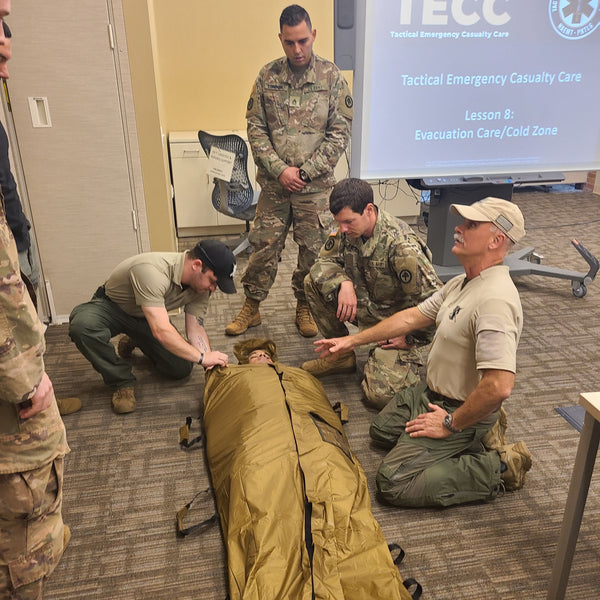
I teach it as a circle, not a triangle, because that's closer to what's actually happening. Bleeding causes shock. Shock and trauma make hypothermia easier to develop, while exposure, cold surfaces, removed clothing, and unwarmed fluids can accelerate it. Hypothermia then makes coagulation work less effectively, because the enzymes that drive clotting don't work efficiently when they're cold. That means more bleeding. More bleeding means worse shock. Round and round, each lap worse than the last, until something breaks the cycle or the patient doesn't survive it.
Bleeding causes shock. Shock and trauma make hypothermia easier to develop. Hypothermia makes coagulation work less effectively. That means more bleeding. More bleeding means worse shock. Round and round, until something breaks the cycle or the patient doesn't survive it.

You don't need to remember the names of all four problems. The important part is that once severe bleeding starts, several physiologic problems can begin feeding one another and make the bleeding harder to stop.
Providers have long called this the lethal triad: hypothermia, acidosis, and coagulopathy, three problems that feed each other. In 2020, a team led by Ricky Ditzel, a former Army Special Operations flight paramedic, published research in the Journal of Trauma and Acute Care Surgery proposing a fourth factor caught in the same loop: hypocalcemia, or low calcium. Hypocalcemia can be present early in severely injured trauma patients, even before transfusion, and citrate contained in transfused blood products can worsen it during resuscitation. Ionized calcium plays an essential role in coagulation as well as cardiac and vascular function, so worsening hypocalcemia can further impair an already compromised patient. Ditzel's research made the case for changing the name from the lethal triad to the lethal diamond, and subsequent research has supported the concept, though lethal triad remains in wide use as well.
None of that changes what you can do on scene with a bleeding patient. But it explains why keeping a patient warm is part of stopping the cycle before it compounds. Warming has a specific physiological job.
Why some patients die weeks later
A patient can arrive at the hospital, have their bleeding controlled, receive blood products, go to the operating room, come out apparently stabilized, and still die days or weeks later from complications set in motion by the original injury and shock.
Stopping the hemorrhage fixes the immediate threat. It doesn't instantly reverse the cellular and organ injury created during the period of inadequate perfusion.
Shock is tissue not getting enough oxygen. When that goes on long enough, organs that were starved during the shock period don't simply resume working normally once blood flow is restored. Kidneys that went without adequate perfusion may fail days later. Lungs can become inflamed and stiff, making oxygenation difficult even with a ventilator. The gut, the liver, the immune system, and the clotting system can all follow. When enough of them fail in sequence, clinicians call it multiple organ dysfunction syndrome, or MODS.
Multiple organ dysfunction remains an important cause of later death after severe trauma. It can be part of a downstream cascade initiated by the original injury, hemorrhage, hypoperfusion, inflammation, and the body's response to all of them. It isn't necessarily a completely separate event that appeared days later. The hemorrhage got fixed. The debt incurred while cells were oxygen-starved came due afterward.
Stopping the bleeding stops the bleeding. It doesn't undo the time the patient spent in shock.
This is why minutes matter even when a patient looks stable. Every minute of inadequate perfusion adds to a bill that may not come due until days later in an ICU.
Controlling hemorrhage early, preventing hypothermia, and shortening the time a patient spends under-perfused all limit how large that bill gets.
One thing worth clarifying: elevating the legs
If you were taught to elevate a shock patient's legs, or to tilt their whole body head down with feet elevated, a technique called Trendelenburg positioning, some of that teaching has changed.
Full Trendelenburg positioning was popularized as a shock treatment during World War I and has been taught in some form for over a century. Current research does not support it as a shock treatment. It does not reliably raise blood pressure or improve outcomes, and it can make breathing harder and increase the risk of aspiration (fluids like blood or vomit getting into the airway) in a patient who is already compromised, because it pushes abdominal contents up against the diaphragm.
For a bleeding trauma patient, don't automatically elevate the legs and don't place them in steep Trendelenburg. A responsive patient is generally kept supine (flat on their back) unless their injuries, airway, or breathing require another position. In nontraumatic shock, current lay first aid guidance still allows modest elevation of the feet, roughly 6 to 12 inches, as an option, not a requirement. If it causes pain, discomfort, or worsens symptoms, return the patient to lying flat. Someone who is awake and struggling to breathe should generally be allowed to assume the position in which they can breathe most comfortably rather than being forced flat solely because they show signs of shock.
It's worth noting that EMS protocols and lay first aid guidance don't line up perfectly here, and that the terminology itself causes confusion. Steep, head-down Trendelenburg positioning and modest elevation of the foot of a stretcher by about six inches are not the same intervention, even though EMS language has historically used the same word for both.
Pennsylvania's statewide BLS Protocol 602, covering multisystem trauma and traumatic shock, is a good example of how that teaching has changed. The instruction to consider Trendelenburg position, defined there as raising the foot of the stretcher approximately six inches in a hypotensive trauma patient with no chest injury, no head injury, and no shortness of breath, appears struck through in the version effective March 31, 2024. The Department of Health marks removed material by striking it through and highlighting it, so the deleted text stays visible in the document and providers can see what changed.
Current lay first aid guidance is more restrictive with trauma patients and reserves modest leg elevation primarily for shock when there is no evidence of injury. If you're a provider, follow your current protocols. If you're a bystander, the practical takeaway is simpler: leg elevation is not the intervention that changes the outcome of severe traumatic bleeding. Controlling hemorrhage, preventing heat loss, activating EMS, and getting the patient to definitive care matter much more.
What actually matters
For laypeople, the interventions taught in most first aid classes are still the right ones. What changes when you understand the why is how you prioritize and adapt them.
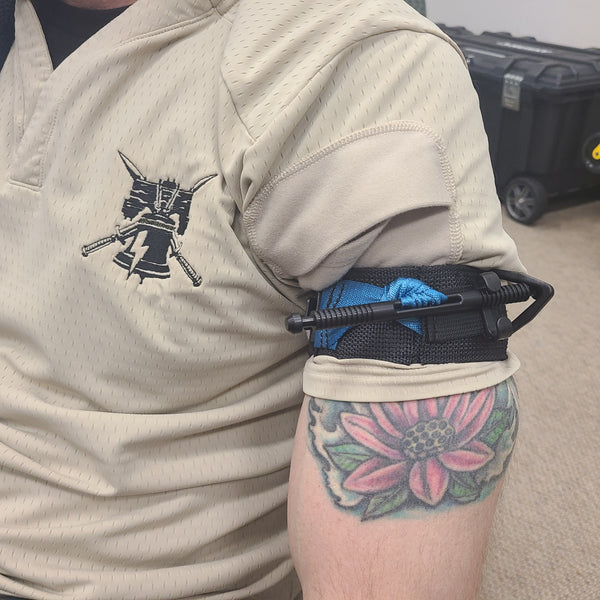
Stop the bleeding. This is the intervention that addresses the root of the cycle. Direct pressure, a tourniquet if it's a life-threatening extremity bleed, packing a wound if you've been trained to. Everything else on this list matters less if the bleeding isn't controlled, because you're trying to empty the tank slower than the bleeding is draining it.
Keep them warm, and understand that this means preventing additional heat loss as well as adding heat when you have the ability to do so. A bleeding trauma patient can become hypothermic rapidly because of blood loss, environmental exposure, wet clothing, cold surfaces, and the physiologic effects of shock. Get them off cold ground, remove or cover wet clothing, insulate them from the environment, and use active warming when available. Pennsylvania's trauma protocol is specific about this, directing providers to use blankets and, if the patient is cold, heat packs at the armpits and groin to prevent additional heat loss. Hypothermia impairs coagulation, and clotting is what ultimately stops the bleeding from the inside. This is treatment, not comfort.
Keep them calm and minimize unnecessary movement or exertion. A bleeding patient doesn't need to be walking around, standing up, or working harder than necessary while their circulating volume is falling.
Position them appropriately. A responsive bleeding patient is generally kept supine if their injuries and breathing permit. Don't put them head-down. If positioning worsens breathing, pain, or other symptoms, don't force it.
In a civilian setting with EMS minutes away, don't give them anything to eat or drink. A seriously injured patient may need anesthesia, procedures, or surgery, and declining mental status increases the risk of vomiting and aspiration.
That guidance changes somewhat in a tactical or prolonged field care environment, and it's worth understanding why. Current TCCC guidance permits oral fluids when a casualty is not in shock, is conscious, and can swallow. A casualty in hemorrhagic shock is managed differently, with blood products preferred for resuscitation when available. The distinction matters because tactical medicine has to account for evacuation time, limited supplies, dehydration, and the possibility that definitive care may be hours away. The physiology hasn't changed. The operational context has.
Monitor for changes, and don't be reassured by a patient who looks stable. Compensated shock can make the body look deceptively stable. Watch skin color, skin temperature, how alert they are, and whether their breathing changes. Those can shift before blood pressure does.
Call for help immediately and get them to definitive care as fast as possible. The window is closing the entire time you're on scene, not just at the end.
What providers can add
For providers, the same actions apply, with the addition of the tools and training your scope allows: hemorrhage control adjuncts, IV or IO access and fluid or blood product resuscitation per your protocols, and active rewarming rather than passive warming alone when you have the equipment for it.
The bigger addition is in how you assess. Don't wait for blood pressure to move before you treat this as urgent. By the time it moves, the patient may already be past compensation and into decompensation. Track trends, not isolated numbers. Look at the entire perfusion picture: mental status, peripheral pulse quality, skin findings, respiratory pattern, heart rate, pulse pressure, and blood pressure trend. No single finding rules hemorrhagic shock in or out. The important question isn't whether one number has crossed a threshold. It's whether the patient's overall physiology is moving in the wrong direction.
Providers may also find trends in shock index, heart rate divided by systolic blood pressure, useful as another piece of the picture. Like every other number in trauma, it should not be interpreted in isolation, but a rising shock index can expose deterioration that a still-normal systolic pressure may hide.
When you don't have a blood pressure
Everything above assumes you can get a blood pressure. Often you can't. No cuff, no working monitor, a noisy environment, a patient who has to be moved right now, or a tactical setting where stopping to take vitals isn't an option.
For decades, providers were taught a workaround: if you can feel a radial pulse, systolic is at least 80. Femoral, at least 70. Carotid only, at least 60. It was clean, easy to remember, and wrong.
Two studies, one in 1988 and one published in the BMJ in 2000, tested that rule against actual measured pressures. Both found it substantially overestimated systolic blood pressure, and the overestimation was worst in the patients who were sickest. In one, the average gap between estimated and actual pressure was 34 mmHg. Patients with palpable radial pulses were frequently far more hypotensive than the rule predicted. The rule was removed from later editions of ATLS. A larger study in 2020 similarly found that characterizing the radial pulse was not a reliable way to identify hypotension.
A palpable radial pulse does not mean the pressure is adequate. It means there is a pulse.
What survived is more useful anyway. In TCCC and similar austere environments, when a blood pressure cannot be obtained, two immediately available clues to circulatory status are the radial pulse, including its presence and quality, and the casualty's mental status.
Rate is how fast it's going. A resting adult is commonly between 60 and 100 beats per minute, though normal varies by person and situation. A pulse climbing above that in an injured patient is worth paying attention to, because a rising heart rate is one of the common early responses to lost volume. What matters more than the number is the direction. A pulse of 110 that was 80 fifteen minutes ago is telling you something a single reading of 110 never could.
Rate also has to be interpreted against the patient in front of you. A conditioned athlete may run low. Someone on beta blockers may not be able to mount a fast heart rate at all. A spinal cord injury can leave a patient with a normal or slow pulse despite significant hypotension. Pain, fear, and stimulant use can drive the rate up without any blood loss involved. Rate is a data point, not a verdict.
Quality is what the pulse feels like under your fingers. A strong pulse is easy to find and pushes back distinctly with each beat. A weak or thready pulse is faint, easy to lose, and sometimes feels like it's flickering rather than beating. You are feeling the pressure wave, so a pulse that is getting harder to find is a sign that less pressure is reaching the periphery, which is exactly what vasoconstriction and falling volume produce together.
The most useful quality finding is a change. A pulse you could find instantly on first contact that now takes several seconds to locate is meaningful. So is one that was full and is now thin. That's why checking once is far less useful than checking repeatedly and remembering what you felt the first time.
Mental status is the brain reporting on its own perfusion. The brain is the organ the body works hardest to protect, so when it starts showing effects, the compensation is being stretched.
The field shorthand is AVPU: is the patient Alert, responsive to Verbal stimulus, responsive only to Pain, or Unresponsive. If they are alert, the follow-up is whether they know who they are, where they are, what happened, and roughly what time it is.
The part that gets missed is that the early changes are often subtle and don't look like what people expect. Anxiety, restlessness, and a sense of impending doom tend to show up early. A patient who keeps trying to get up, who seems agitated out of proportion to the situation, or who repeats the same question is giving you information. New combativeness in an injured patient should raise concern for hypoxia, worsening perfusion, or brain injury before anyone treats it as a behavior problem. Lethargy, confusion, and unresponsiveness generally come later. By the time someone is difficult to rouse, you are well past the early window.
Mental status has its own confounders, and they matter. Traumatic brain injury, hypoxia, alcohol, drugs, hypoglycemia, pain, and the psychological effect of the event itself can all alter someone's presentation independent of their circulatory status. None of that makes mental status useless. It means you interpret it alongside everything else rather than in isolation.
Put together, a radial pulse that is present but fast and weak tells you something. One that was strong ten minutes ago and is thready now tells you more. A casualty who was oriented and is now confused, combative, or unusually quiet has given you important evidence that perfusion may be worsening, potentially before a single cuff reading tells the whole story. Neither finding is a number, and that's the point. You're tracking the direction the patient is moving, which is the same thing the shock index is trying to show you, using the tools you actually have.
Back to the numbers
Bleeding-control training is right that severe hemorrhage can become fatal within minutes, and combat data are right that controlling life-threatening hemorrhage before shock develops makes an enormous difference in survival. Both of those points are true and worth knowing. What they don't fully capture is what happens during the window when the patient can still look stable while the reserve keeping them that way is being consumed.
Understanding compensated shock, what it is, what it hides, and how fast it can turn, is what closes that gap. Not the numbers themselves. The why behind them.
References and further reading
- Kragh JF Jr, Walters TJ, Baer DG, Fox CJ, Wade CE, Salinas J, Holcomb JB. Survival with emergency tourniquet use to stop bleeding in major limb trauma. Annals of Surgery. 2009;249(1):1-7. The combat study reporting markedly higher survival when tourniquets were applied before shock was present.
- Kragh JF Jr, Littrel ML, Jones JA, Walters TJ, Baer DG, Wade CE, Holcomb JB. Battle casualty survival with emergency tourniquet use to stop limb bleeding. Journal of Emergency Medicine. 2011;41(6):590-597. The larger follow-on analysis of the same population.
- Ditzel RM Jr, Anderson JL, Eisenhart WJ, Rankin CJ, DeFeo DR, Oak S, Siegler J. A review of transfusion- and trauma-induced hypocalcemia: Is it time to change the lethal triad to the lethal diamond? Journal of Trauma and Acute Care Surgery. 2020;88(3):434-439. The paper proposing hypocalcemia as a fourth factor alongside hypothermia, acidosis, and coagulopathy.
- Naylor JF, Fisher AD, April MD, Schauer SG. An analysis of radial pulse strength to recorded blood pressure in the Department of Defense Trauma Registry. Military Medicine. 2020;185(11-12):e1903-e1907. Found that radial pulse quality correlated with average systolic pressure but was not reliable for identifying individual casualties with severe hypotension.
- Deakin CD, Low JL. Accuracy of the advanced trauma life support guidelines for predicting systolic blood pressure using carotid, femoral, and radial pulses: observational study. BMJ. 2000;321(7262):673-674. Found the palpable-pulse rule substantially overestimated actual systolic pressure.
- Poulton TJ. ATLS paradigm fails. Annals of Emergency Medicine. 1988;17(1):107. The earlier study reaching the same conclusion by a different method.
- STOP THE BLEED. American College of Surgeons Committee on Trauma. Public bleeding-control training and the source of the widely cited warning that severe bleeding can be fatal within minutes.
- Deployed Medicine. Committee on Tactical Combat Casualty Care guidelines and current TCCC curriculum materials.
- Committee on Tactical Emergency Casualty Care. TECC guidelines adapting combat casualty care principles to the civilian operational environment.
- Pennsylvania Department of Health, Bureau of Emergency Medical Services. Statewide BLS Protocol 602, Multisystem Trauma or Traumatic Shock. Effective March 31, 2024. The revision in which the Trendelenburg position instruction was removed.
- American Heart Association and American Red Cross. 2024 Guidelines for First Aid. Current guidance on positioning patients showing signs of shock, including the distinction between traumatic and nontraumatic presentations.
Field Notes content is written by active practitioners and reviewed for accuracy at the time of publication. Medical protocols, clinical guidelines, and agency standards evolve. Always verify against your current local protocols and medical director guidance before applying anything in the field. If content has been updated since original publication, changes will be noted within the article.