Stop the Bleed worked. Now civilian EMS medical directors need to authorize the next step.

On October 4, 2015, the federal government formally launched the Stop the Bleed campaign. A decade later, the program has produced exactly what it was designed to produce. Civilians are recognizing severe hemorrhage faster, intervening earlier, and applying tourniquets in the field before EMS arrives. The same decade saw patrol-officer tourniquet training expand from a handful of progressive departments to a baseline expectation at most agencies. Federal grant funding has put commercial tourniquets in patrol vehicles across all fifty states. The institutional investment in pre-EMS hemorrhage control has been one of the most successful public-safety education campaigns in modern American history.
Those programs did their job. They are still doing it. Lives that would have been lost ten years ago are being saved at the scene now, before the first paramedic opens their kit. The problem is what happens after the bystander applies the tourniquet.
When EMS arrives minutes later, the trained paramedic or EMT in the back of the ambulance is now standing over a patient with a tourniquet already in place. In a meaningful percentage of those cases, that tourniquet was applied to a wound that did not require it. The bystander could not tell. The patrol officer could not tell. They were trained to act when bleeding looked life-threatening, and they did exactly what their training said to do. The trained EMS provider arriving on scene has clinical assessment skills that the bystander does not have. They can look at the wound, assess the bleeding, and determine whether the tourniquet was clinically necessary.
In many cases, it was not.
What the current protocol environment in most civilian EMS systems says to do at that point is: leave it on, transport, let the hospital deal with it. That guidance was written for a world that no longer exists. It was written when tourniquets were applied almost exclusively by trained medics in genuinely life-threatening hemorrhage. The volume of pre-EMS tourniquet applications was low. The clinical question of "did this patient actually need the tourniquet that was just applied" was rare enough that a default of "leave it on, transport" produced acceptable outcomes.
That world is gone. Stop the Bleed made it disappear. Patrol-officer training accelerated the change. The volume of pre-EMS tourniquet applications has grown substantially over the last decade. The protocol environment that EMS providers work inside has not caught up.
Stop the Bleed worked. Patrol officer training worked. The protocol environment they created has not caught up to the success they produced.
This piece is for the medical directors who write the protocols that working medics operate under, and for the state EMS authorities whose scope-of-practice decisions determine whether those medical directors have room to operationalize the evidence. The argument is that EMS providers should be authorized to evaluate, and where clinically appropriate, convert tourniquets that were applied by lay bystanders and law enforcement officers in the moments before EMS arrival. The evidence supporting conversion in selected patients has been clear since 2015. The 2026 TCCC Guidelines update codified what the evidence has been telling us. The Committee for Tactical Emergency Casualty Care issued its Final 2025 Guidelines for BLS/ALS Clinicians, which include a complete conversion framework. The civilian institutional pathway is now built. State EMS authorities and the medical directors who advocate to them are the remaining bottleneck.
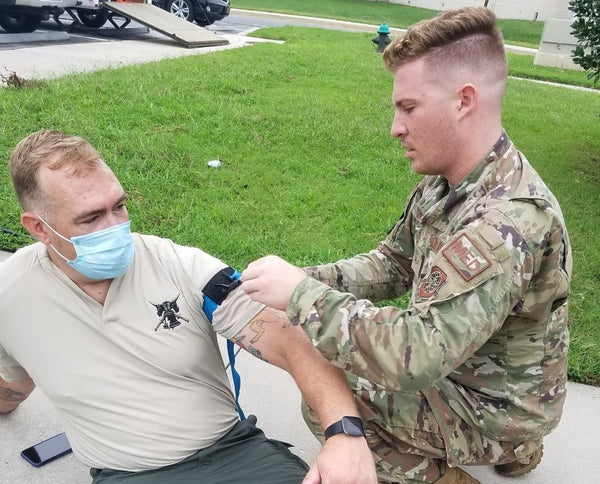
Throughout this article, tourniquet conversion refers to replacing tourniquet-based hemorrhage control with another hemorrhage-control strategy, typically direct pressure, wound packing, hemostatic gauze, or a pressure dressing, while maintaining the ability to rapidly reapply the tourniquet if bleeding resumes. Conversion is not removal. Conversion is a controlled substitution of one hemorrhage-control method for another, performed by a trained provider with continuous reassessment.
What this article is not arguing
The argument here is institutional, not adversarial. To be clear about what this article is not saying:
This article is not arguing against Stop the Bleed. The program is one of the most successful public-safety education campaigns in modern American history, and the decision rule it teaches bystanders is the correct rule for that audience.
This article is not arguing against aggressive early hemorrhage control. The clinical evidence supporting rapid tourniquet application in life-threatening extremity hemorrhage is overwhelming. Underuse is far more dangerous than overuse.
This article is not arguing against patrol-officer tourniquet application. Officers should continue to carry and apply tourniquets exactly as they are currently trained to do.
This article is not arguing for unstructured field removal of tourniquets, or for reducing civilian hemorrhage-control capability in any way.
What this article is arguing is that trained EMS providers should have protocolized authority to reassess hemorrhage-control interventions that were placed upstream by providers operating under intentionally simplified decision rules. The bystander decision rule is correct for the bystander. The patrol officer decision rule is correct for the patrol officer. Neither rule is correct for the trained paramedic, who has the clinical assessment skills to make a more refined decision. The protocol environment should reflect that difference.
A recent call
Last week my crew was dispatched to a laceration call in a difficult-access location, away from any main road, on terrain that would have required us to deploy the UTV if the patient could not assist with the extraction. A patrol officer arrived on scene before us. He saw a puddle of blood on the ground next to the patient. The patient was uncooperative and was holding a T-shirt over the wound, refusing to lift it for the officer to assess what was underneath. The officer applied a tourniquet.
I want to say this clearly because it matters for the rest of the article: the officer made the right decision. He was the first medical responder on a scene with visible blood loss. The patient was not letting him see the wound. He had no way to know my crew was minutes behind him. The decision rule he was trained to follow says apply the tourniquet when you cannot rule out life-threatening hemorrhage. He applied the tourniquet. He did his job.
When I arrived, the patient was still uncooperative but I was able to assess the wound. It was a laceration on the palm of the hand. The bleeding was not life-threatening. The blood puddle on the ground was real but not arterial. Direct pressure and a pressure dressing would have controlled this wound completely. The tourniquet was not needed.
Given current protocols, my only option was to verify the tourniquet was tight enough, document the application time, and prepare the patient for transport.
The officer did the right thing. I did the right thing. The protocol did the wrong thing. The patient went to the hospital with an unnecessary tourniquet in place because the institutional environment did not give me the authority to make a different decision, even though I had the clinical assessment to support one.
This is the protocol gap. The officer was operating correctly under his decision rule. I was operating correctly under mine. The decision rules were calibrated for two different providers with two different capability sets, but the protocol environment treated them as if the second provider had no additional capability to bring to the decision.
The clinical consequence
A trained paramedic has the clinical assessment skills to evaluate a wound and determine whether a tourniquet was clinically necessary. They can look at the wound location, the wound depth, the bleeding pattern, the patient's hemodynamic status, and the time since application. They can determine whether direct pressure or a pressure dressing would control bleeding if the tourniquet were converted. They can monitor the patient for rebleeding during transport. These are skills within the scope of standard paramedic training.
When that paramedic arrives at a scene where a Stop the Bleed-trained bystander or a patrol officer has already applied a tourniquet, the paramedic is in a clinical position to ask a question the bystander could not ask. Does this patient need this tourniquet?
The protocol environment in most civilian EMS systems does not let them answer that question. The standing order in most agencies says: leave the tourniquet in place, transport, document the application time, let the receiving facility manage conversion or removal. The paramedic's clinical assessment is irrelevant. The protocol does not give them a decision to make.
This default produces predictable consequences. Tourniquets that should have been converted in the first thirty minutes after application instead stay in place for the full transport time. Patients arrive at the emergency department with sixty to ninety minutes of tourniquet time on a wound that direct pressure would have controlled. The tissue ischemia is unnecessary. The pain is unnecessary. The patient anxiety and the increased need for analgesia are unnecessary. The downstream complications, ranging from prolonged hospital stays to compartment syndrome to rare but real cases of preventable amputation, are unnecessary.
None of this is hypothetical. The civilian data already exists. Mikdad et al. (2021), in a paper directly titled "Implications of the National Stop the Bleed Campaign: The Swinging Pendulum of Prehospital Tourniquet Application in Civilian Limb Trauma," documented exactly this pattern. The success of Stop the Bleed is producing more tourniquet applications. A significant portion of those applications are clinically unnecessary by the time a trained provider evaluates them. The civilian EMS response has not adapted.
Many civilian systems remain institutionally conservative because maintaining a tourniquet often feels operationally and legally safer than reassessment, even when reassessment may better serve the patient physiologically. That conservatism is understandable. It is also why the protocol environment has not moved on its own. Institutional inertia does not get displaced by clinical evidence alone. It gets displaced by clinical evidence combined with a clear institutional pathway that addresses the legal and operational concerns directly.
The protocol environment treats those two providers as if they have the same clinical training, and they do not.
The success that created the problem
Two numbers establish the scale.
The first comes from Kragh et al. (2009), the foundational military study on tourniquet use in Iraq. Of the prehospital tourniquets reviewed in that paper, up to 49 percent of applications could not, in retrospect, be classified as clinically necessary. The wounds did not require a tourniquet to stop bleeding. Direct pressure, hemostatic gauze, or a pressure dressing would have controlled the hemorrhage. The tourniquet was applied because the responder could not be certain in the moment.
The second comes from Scerbo et al. (2016), the corresponding civilian dataset. In a review of 105 civilian tourniquet applications, 53 percent could not be classified as clinically necessary in retrospect. The same overuse pattern that emerged in combat has emerged in civilian practice. The Stop the Bleed program is now training civilians using the same "when in doubt, apply" decision rule that produced the 49 percent military overuse rate. The result is predictable. More tourniquets are being applied. Many of them did not need to be.
This is not a criticism of the training. The decision rule is correct for an untrained bystander. A civilian with twenty minutes of Stop the Bleed instruction cannot reliably differentiate life-threatening extremity hemorrhage from minor or moderate bleeding that direct pressure would control. Their decision rule is "apply when in doubt." That rule produces some unnecessary applications. It also produces saved lives that would not have been saved if the rule were more conservative. The trade-off is correct at the bystander level.
The same logic applies at the patrol-officer level. An officer with TECC-LE or similar training has more clinical context than a civilian, but they are still trained to apply rather than to evaluate. The decision rule for a patrol officer arriving on a shooting scene, or on a laceration scene where the patient is uncooperative, is "apply the tourniquet, secure the scene, wait for EMS." That rule produces some unnecessary applications. It also produces saved lives. The trade-off is correct at the patrol-officer level.
The trade-off shifts when EMS arrives.
What the evidence says
The clinical case for tourniquet conversion is not new. It is not contested in the academic literature. The evidence base supporting EMS-level conversion in selected cases has been accumulating for more than a decade.
Drew et al. (2015) published the foundational protocol for tourniquet conversion in prolonged field care, establishing the clinical framework that all subsequent guidance has built on. The same year, Shackelford et al. (2015) formalized the TCCC guidance on optimizing tourniquet use, including conversion, in TCCC Guidelines Change 14-02. Both papers established that conversion in selected cases was clinically appropriate, evidence-supported, and within the scope of trained medical providers.
Holcomb et al. (2023) updated the framework with what the authors describe as "rethinking limb tourniquet conversion in the prehospital environment." The paper draws on military experience from Iraq and Afghanistan, civilian trauma center data, and emerging evidence from the Russo-Ukrainian War. The conclusions are clinically clear. Tourniquet use under two hours is generally safe even when the application was not clinically necessary. Tourniquets in place for more than two hours risk significant ischemic injury. Tourniquets under six hours should have conversion or replacement attempted by trained providers when clinically appropriate. The window for safe conversion is substantial, especially in civilian EMS where transport times are usually under two hours.
The most recent and most directly applicable institutional reference for civilian EMS is the Committee for Tactical Emergency Casualty Care (C-TECC) Guidelines for BLS/ALS Clinicians, Final 2025-1-2. C-TECC is the civilian-environment authoritative committee that translates TCCC principles into operational guidance for civilian tactical, rescue, and EMS operations. The Final 2025 update establishes a complete tourniquet conversion framework with explicit clinical criteria, technique definitions, and provider-level authorization.
The C-TECC 2025 framework defines four criteria for tourniquet downgrade or conversion: the patient is not currently in hemorrhagic shock, the wound can be subsequently monitored closely, the tourniquet is not on an amputated or partially amputated limb, and no prior unsuccessful attempts to remove the tourniquet have occurred. The framework distinguishes between two procedures. Relocation moves the tourniquet to a position 2-3 inches above the injury, applied directly to skin, with the original tourniquet loosened but left in place. Conversion fully packs the wound with hemostatic or plain gauze, applies a pressure dressing, and then loosens the original tourniquet, again leaving it in place. If a conversion attempt fails, it should not be attempted multiple times.
The framework applies across all three phases of the C-TECC care construct (Direct Threat, Indirect Threat, and Evacuation) and authorizes both BLS and ALS clinicians to perform conversion under appropriate clinical criteria. The C-TECC 2025 update also explicitly addresses unnecessary tourniquets in the Evacuation Care phase: "If a tourniquet is determined based on wound assessment to not be clinically indicated, use other techniques to control bleeding and then remove the tourniquet."
This is the civilian-environment institutional pathway in current published form. It is not military doctrine. It is not theoretical. It is a Final 2025 guideline issued by the civilian authoritative committee, addressed to civilian BLS and ALS clinicians, applicable across the full civilian EMS operational environment.
A guideline is not a protocol. The C-TECC document explicitly states that the TECC guidelines are "scope of practice dependent" and require "a systems approach that accounts for the totality of the event." Application of the C-TECC principles is, in the document's own words, "agency, provider, practitioner, and resource specific." A C-TECC guideline does not automatically become operational practice. State EMS authorities decide whether and how to incorporate the framework into state-level scope of practice. Medical directors decide whether and how to operationalize state authorization into agency standing orders.
The remaining institutional work is the work of state EMS authorities and medical directors. The clinical evidence is settled. The civilian-environment guideline is published. The pathway from guideline to protocol is the bottleneck.
The most recent operational evidence comes from the Russo-Ukrainian War. The Joint Trauma System's February 2025 review documented what happens when tourniquets stay in place longer than clinically necessary. Evacuation times in Ukraine sometimes reach twelve to twenty-four hours. Prolonged Tourniquet Application Syndrome emerged as a major cause of morbidity, producing amputations, compartment syndromes, electrolyte abnormalities, and acute kidney injury. The Armed Forces of Ukraine responded by formally adopting a policy on July 18, 2023, authorizing tourniquet conversion and replacement by anyone trained to perform the task, with telemedicine support where available.
The Ukrainian military authorized broader conversion practice in response to evidence. The American civilian EMS system, operating with transport times that rarely exceed two hours, has not.
The Butler et al. (2024) review on tourniquet use in the Russo-Ukrainian War reaches the same conclusion. The combination of civilian overuse data, military overuse data, and the Ukrainian morbidity experience all point in the same direction. First responders need better training on when tourniquets are needed and when they are not. Trained medical providers need authorization to convert tourniquets that were not necessary in the first place.
The state authorization layer
The institutional pathway from C-TECC guideline to working-medic practice runs through two layers, not one. Both need to engage for the protocol environment to actually change.
The first layer is the state EMS authority. In Pennsylvania, that authority sits with the Bureau of EMS within the Department of Health. State EMS authorities define the scope of practice for each provider level. They publish statewide protocols that establish the floor for what every EMS agency in the state must do, and they define the ceiling for what an individual medical director can authorize. A medical director in Pennsylvania cannot authorize a paramedic to perform a procedure that is outside the scope defined by the Pennsylvania statewide ALS protocols, regardless of how clinically supported that procedure is.
Pennsylvania, like most states, has not directly addressed tourniquet conversion in its statewide protocols. The PA Bureau of EMS has not issued guidance on whether conversion is within or outside the scope of paramedic practice. The C-TECC 2025 framework has not been formally evaluated for adoption. The institutional question of whether a Pennsylvania paramedic can convert a tourniquet under appropriate clinical criteria has not been answered at the state level.
Pennsylvania is not unusual. Most states have not addressed conversion. The civilian protocol environment is, in effect, silent on a question that the clinical evidence and the C-TECC guideline have both answered.
The second layer is the agency medical director. Where state scope permits a procedure, the medical director writes the standing order that authorizes their agency's providers to perform it. Where state scope is ambiguous or silent, the medical director carries institutional risk in authorizing the procedure under existing scope, and may need to advocate to the state EMS office for explicit scope clarification or expansion before operationalizing.
This means there are two paths forward for any medical director who reads this article and wants to operationalize conversion authorization.
The first path is internal to the agency. In states where existing paramedic scope clearly permits the clinical decision-making and procedure that conversion involves, the medical director can move directly to drafting a standing order, building the training pathway, and establishing the QA review process. The article's framework section gives the structure.
The second path is upstream to the state. In states where existing scope is ambiguous or silent on conversion specifically, the medical director may need to engage the state EMS office before operationalizing. This is the harder institutional work but it is also the work that produces durable change. A state EMS scope clarification that explicitly addresses conversion creates protected authority for every medical director in the state. An agency-level standing order in the absence of state guidance creates authority only for the providers in that agency, and carries more institutional risk for the medical director who signs it.
Pennsylvania medical directors who want to push this conversation upstream can engage the Bureau of EMS through the established channels: regional EMS council representation, medical advisory committee participation, and direct communication with the State EMS Medical Director. The C-TECC 2025 Final Guidelines provide the authoritative civilian-environment reference that the conversation can be built around.
The clinical decision points
A civilian tourniquet conversion protocol does not need to authorize conversion in all cases. The C-TECC 2025 framework and the Holcomb 2023 paper converge on the clinical decision points that determine when conversion is appropriate.
Time since application. Tourniquets in place less than two hours have low ischemic injury risk. Conversion in this window is clinically straightforward in selected cases. Tourniquets in place two to six hours have elevated ischemic risk but conversion remains the recommended approach when criteria are met. Tourniquets in place more than six hours should generally be left in place pending surgical evaluation.
Hemodynamic stability. Patients who are or have been in shock should not have tourniquet conversion attempted in the field. The risk of reperfusion-related decompensation is too high. The C-TECC 2025 framework requires that the patient is not currently in hemorrhagic shock. Hemodynamically stable patients with controlled vital signs are the appropriate candidates for conversion.
Wound characteristics. Three categories of patient, drawn from the Holcomb 2023 framework, define the decision space. Wounds with minor injury and no major vascular damage are the cleanest conversion candidates. Wounds with major vascular injury but controlled bleeding can often be safely converted to a pressure dressing. Wounds with active bleeding that resumes when the tourniquet is loosened require tourniquet replacement rather than conversion. Wounds involving total or near-total amputation are not candidates for conversion. The C-TECC framework restates this clearly: the tourniquet must not be on an amputated or partially amputated limb.
Provider certification level. The C-TECC 2025 framework authorizes both BLS and ALS clinicians to perform conversion under the same clinical criteria. State scope of practice may differ. Medical directors should align their authorization with state scope, recognizing that the clinical assessment skill requirements are consistent regardless of certification level.
Single attempt rule. The C-TECC 2025 framework is explicit: if a tourniquet downgrade or conversion fails, it should not be attempted multiple times. One attempt, clean assessment, and either commit to the converted state or return to tourniquet control. Repeated attempts increase the risk of provider hesitation, patient discomfort, and clinical confusion.
The decision framework is not complex. It is the kind of decision tree a competent paramedic already uses for other interventions. The question is not whether paramedics have the clinical skills to make these decisions. They do. The question is whether the state EMS authority has defined scope to include the decision, and whether the medical director has authorized the providers to use it.
What a protocol should include
A civilian tourniquet conversion protocol should establish four things. First, the clinical criteria for when conversion may be attempted. Second, the provider certification level authorized to perform the conversion. Third, the technique to be used. Fourth, the documentation and QA pathway.
The clinical criteria should mirror the C-TECC 2025 framework. The patient must not be in hemorrhagic shock. The wound must allow continuous monitoring during transport. The injury must not involve total or near-total amputation. No prior unsuccessful conversion attempt should have occurred. The bleeding must be controllable by direct pressure, a pressure dressing, or hemostatic gauze.
The provider authorization should specify which certification levels are authorized to perform conversion under the protocol, aligned with state scope of practice. The C-TECC framework authorizes both BLS and ALS clinicians, but state-level scope decisions take precedence in any specific jurisdiction.
The technique language should reference the established conversion procedure. Pack the wound. Apply direct pressure. Loosen the tourniquet while maintaining the ability to retighten if bleeding resumes. Apply a pressure dressing. Continue to monitor for rebleeding throughout transport. Do not attempt a second conversion if the first attempt fails.
The documentation requirement should include time of original application (or estimated time), time of conversion attempt, provider performing conversion, wound characteristics, bleeding status before and after conversion, and patient vital signs at conversion.
This is the framework. The specific protocol language belongs in the medical director's hands, within the scope defined by the state EMS authority. Penn Tactical Solutions can provide training resources for the providers who will operate under the protocol, but the protocol itself should be written by the medical director who carries responsibility for it.
Oversight must evolve alongside capability
A protocol that authorizes new clinical authority is not safe without the oversight infrastructure that surrounds it. The QA and CQI framework that supports a conversion protocol is as important as the protocol itself, and in many systems will require more institutional work to build than the protocol language does.
A functional QA pathway for a conversion protocol should include several elements. Every conversion attempt in the first year under the protocol should be reviewed individually, with attention to clinical decision-making, technique adequacy, documentation quality, and outcomes. Patterns across multiple cases should be analyzed quarterly: which providers are converting at higher or lower rates than their peers, what wound presentations are being converted versus left in place, how often conversions are followed by rebleeding events requiring reapplication, and what the receiving-facility outcomes look like for converted versus non-converted patients. Provider feedback should be routine, not exceptional. A medic who converts a tourniquet should expect to hear back from the QA process whether the decision was supported.
Many patrol medical programs already include QA/CQI review pathways for tourniquet applications, recognizing that widespread hemorrhage-control capability requires oversight and continuous improvement. Penn Tactical Solutions offers a patrol officer medical toolkit with QA/CQI documentation forms designed for exactly this kind of review structure. EMS conversion protocols should be implemented with the same mindset and a similar documentation architecture, scaled to the agency's provider count and application volume.
The QA pathway is also the mechanism by which the medical director maintains visibility into how the new authority is being used. Without it, a conversion protocol becomes an unmonitored expansion of scope. With it, the protocol becomes an iteratively-refined operational practice that produces better outcomes year over year.
Why this matters now
The Stop the Bleed program is not going to slow down. Patrol-officer training is not going to slow down. The federal investment in pre-EMS hemorrhage control is going to continue. The volume of pre-EMS tourniquet applications is going to keep growing. The percentage of those applications that are clinically unnecessary, by the time a trained provider evaluates them, is going to remain in the same range Mikdad and Scerbo documented.
Every year of delay is a year of patrol-applied and bystander-applied tourniquets being transported intact when conversion was clinically appropriate. Every year is patients paying tissue cost for an institutional decision. The institutional decision is not "should EMS providers convert tourniquets," because the evidence supporting conversion in selected patients has been clear since 2015 and the C-TECC 2025 framework has now formalized the civilian-environment guideline. The institutional decision is "should state EMS authorities evaluate the C-TECC framework for scope inclusion, and should medical directors operationalize the resulting authorization in agency standing orders."
Every patrol-applied tourniquet that gets transported intact when it could have been safely converted is a patient who is paying tissue cost for an institutional decision.
There is a historical parallel worth noting. After World War II, the United States Army surgeon general's office issued guidance that effectively discouraged tourniquet use for the next six decades. The guidance was a response to documented tourniquet overuse in the European Theater. Soldiers and medics had applied tourniquets unnecessarily, left them in place too long, and produced limb-loss outcomes that should not have occurred. (It's also important to note that theses we're the "Strap and Buckle" tourniquets that probably stopped venous blood but not arterial blood) The institutional response was to swing the pendulum hard the other direction. Tourniquets fell out of favor. Two generations of military medics trained in a doctrine that treated tourniquets as a last resort. The pendulum did not swing back until Butler's 1996 paper and the subsequent TCCC reforms.
The cost of that overcorrection was measurable. Soldiers and Marines bled to death in Korea, in Vietnam, in Somalia, in Iraq, and in Afghanistan from extremity hemorrhage that a properly applied tourniquet would have controlled. The institutional decision to swing away from tourniquet use produced sixty years of preventable mortality.
The current civilian moment is the mirror image of that historical pattern. Tourniquets are now applied at high volume by minimally-trained responders. The clinical literature is documenting overuse. The temptation, in the absence of clear protocol guidance, is to push back against Stop the Bleed and patrol-officer training. The pendulum could swing the other way again. That would be the wrong response. The right response is what Butler and the TCCC reformers did with combat tourniquet use after 1996. Take the success seriously. Document where it works and where it does not. Build the protocol environment that allows trained providers to manage the consequences of the success.
Civilian EMS is at a 1996 moment, in reverse. The training has worked. The volume of applications is high. The protocol environment has to catch up.
What the medical director can do
For the medical director reading this who is considering the protocol change, the institutional pathway has two starting points depending on what state scope of practice already permits.
First, review the existing literature and the C-TECC 2025 framework. The Holcomb 2023 paper, the JTS February 2025 review, the Butler 2024 Russo-Ukrainian War analysis, the Mikdad 2021 paper on Stop the Bleed implications, and the C-TECC 2025 Final Guidelines provide the evidence base and the civilian-environment institutional reference. The full citations are at the end of this article.
Second, determine where your state EMS scope of practice stands on conversion. Pennsylvania, like most states, has not directly addressed conversion in its statewide protocols. Review your state's published protocols and contact your state EMS office if scope is ambiguous. The answer to this question determines whether you move directly to agency protocol drafting or whether you need to engage upstream first.
Third, where state scope permits, draft the protocol language with clinical criteria, provider authorization, technique reference, and documentation requirements. The C-TECC 2025 framework gives the structure. Adapt to local context, agency provider mix, and transport time profile.
Fourth, where state scope does not clearly permit conversion, engage your state EMS authority. In Pennsylvania, this means working through regional EMS council representation, medical advisory committee participation, or direct communication with the State EMS Medical Director. Provide the C-TECC 2025 reference. Make the case for scope inclusion or scope clarification. This is the institutional work that produces durable change for every medical director in the state, not just for your agency.
Fifth, build the training pathway that supports the protocol. Providers who will operate under the new protocol need training on the conversion technique, the decision criteria, and the documentation requirement. This is the kind of continuing-education content that fits into existing protocol-update training cycles. It does not require new infrastructure.
Sixth, establish the QA review process described in the previous section. The review is the mechanism by which the protocol gets refined over time and the providers get the feedback they need to make better decisions.
Seventh, communicate the change to the receiving facilities. Emergency physicians, trauma surgeons, and ED nursing staff need to know that converted tourniquets may now be presenting at triage with documentation of field conversion. The receiving-facility communication is the kind of institutional coordination that medical directors do well when the change is communicated clearly.
None of these steps is unusual. They are the standard institutional process for any protocol update. The unusual part is that the protocol update has been clinically warranted since 2015, formalized in civilian-environment guideline form in 2025, and has not happened in most civilian systems.
The closing argument
The upstream hemorrhage-control revolution already happened. Civilians, patrol officers, and minimally trained responders now intervene in severe bleeding faster than at any point in American civilian trauma care history. The federal investment, the training infrastructure, the public-awareness campaign, the patrol-officer training programs, the equipment placement in vehicles and public spaces. All of it worked. The program produced exactly the outcome it was designed to produce. Some unknown number of people who would have died are alive because the training worked.
The institutional task in front of state EMS authorities and EMS medical directors is no longer deciding whether aggressive hemorrhage control works. It does. The task now is building the reassessment and conversion framework that allows trained medical providers to safely manage the consequences of that success.
The clinical skills are already there. The evidence base is already there. The civilian-environment guideline is published and current. The C-TECC 2025 Final Guidelines for BLS/ALS Clinicians give state EMS authorities a complete framework to evaluate for adoption. The 2026 TCCC Guidelines update codified what has been clinically clear for a decade. The remaining bottleneck is the state-level scope of practice decision and the agency-level protocol that follows from it. State EMS authorities and the medical directors who advocate to them are the people who can move it.
Stop the Bleed worked. Now civilian EMS medical directors need to authorize the next step.
References
- Committee for Tactical Emergency Casualty Care. TECC Guidelines for BLS/ALS Clinicians, Final 2025-1-2. January 2025.
- Holcomb JB, Dorlac WC, Drew BG, et al. Rethinking limb tourniquet conversion in the prehospital environment. J Trauma Acute Care Surg. 2023;95(6):e54-e60.
- Butler FK, Holcomb JB, Dorlac WC, et al. Who needs a tourniquet? And who does not? Lessons learned from a review of tourniquet use in the Russo-Ukrainian war. J Trauma Acute Care Surg. 2024;97(2S):S45-S54.
- Drew B, Bird D, Matteucci M, Keenan S. Tourniquet conversion: a recommended approach in the prolonged field care setting. J Spec Oper Med. 2015;15(3):81-85.
- Shackelford SA, Butler FK Jr, Kragh JF Jr, et al. Optimizing the use of limb tourniquets in tactical combat casualty care: TCCC guidelines change 14-02. J Spec Oper Med. 2015;15(1):17-31.
- Kragh JF Jr, Walters TJ, Baer DG, et al. Survival with emergency tourniquet use to stop bleeding in major limb trauma. Ann Surg. 2009;249(1):1-7.
- Scerbo MH, Mumm JP, Gates K, et al. Safety and appropriateness of tourniquets in 105 civilians. Prehosp Emerg Care. 2016;20(6):712-722.
- Mikdad S, Mokhtari AK, Luckhurst CM, et al. Implications of the national stop the bleed campaign: the swinging pendulum of prehospital tourniquet application in civilian limb trauma. J Trauma Acute Care Surg. 2021;91(2):352-360.
- Mokhtari AK, Mikdad S, Luckhurst C, et al. Prehospital extremity tourniquet placements: performance evaluation of non-EMS placement of a lifesaving device. Eur J Trauma Emerg Surg. 2022;48(5):4255-4265.
- Hashmi ZG, Hu PJ, Jansen JO, et al. Characteristics and outcomes of prehospital tourniquet use for trauma in the United States. Prehosp Emerg Care. 2023;27(1):31-37.
- Scerbo MH, Holcomb JB, Taub E, et al. The trauma center is too late: major limb trauma without a pre-hospital tourniquet has increased death from hemorrhagic shock. J Trauma Acute Care Surg. 2017;83(6):1165-1172.
- Berry C, Gallagher JM, Goodloe JM, et al. Prehospital hemorrhage control and treatment by clinicians: a joint position statement. Prehosp Emerg Care. 2023;27(5):544-551.
- Joarder M, Noureddine El Moussaoui H, Das A, et al. Impact of time and distance on outcomes following tourniquet use in civilian and military settings: a scoping review. Injury. 2023;54(5):1236-1245.
- Quinn J, Panasenko SI, Leshchenko Y, et al. Prehospital lessons from the war in Ukraine: damage control resuscitation and surgery experiences from point of injury to role 2. Mil Med. 2023;usad253.
- Joint Trauma System. Save Lives. Learn When and How to Properly Use Tourniquets. February 25, 2025.
- Butler FK Jr, Hagmann J, Butler EG. Tactical combat casualty care in special operations. Mil Med. 1996;161(Suppl):3-16.
Field Notes content is written by active practitioners and reviewed for accuracy at the time of publication. Medical protocols, clinical guidelines, and agency standards evolve. Always verify against your current local protocols and medical director guidance before applying anything in the field. If content has been updated since original publication, changes will be noted within the article.