Whole Blood Is Here. We're Still Getting the Basics Wrong Around It

The case for moving blood products closer to the bleeding patient is strong enough that prehospital transfusion programs have expanded rapidly over the last decade. Whole blood offers an elegant way to do that, delivering red cells, plasma, and platelets in a single product. The evidence for prehospital blood generally is still evolving. NAEMSP's own 2025 position statement, while recommending the practice in systems that can support it well, describes the underlying literature as poorly defined with significant heterogeneity in quality, and found that among the different prehospital transfusion approaches it reviewed, no single one was consistently superior to the others. A randomized UK trial, RePHILL, separately found that prehospital red cells plus plasma were not superior to saline for the trial's primary composite outcome. That makes the logistics around when blood actually reaches the patient matter more, not less. The case for the product is strong enough to justify getting the delivery right, rather than treating the act of carrying it as sufficient on its own. This piece is about where and how some programs are staging whole blood, and why that staging is quietly working against the same physiology it's supposed to fix. The populations who need it most are often the ones least likely to have it on the truck that reaches them.
Two different failure modes hide inside that sentence, and they don't look anything alike. One shows up in rural systems that can't sustain a blood program at all. The other shows up in well-resourced systems sitting right next to a trauma center, where the blood exists and still doesn't reach the patient as fast as it should. Both come from the same root mistake: treating whole blood as a specialty resource to be summoned, rather than a primary capability that rides with the patient from the first unit on scene.
The rural problem: the logistics disqualify the population that needs it most
Whole blood has a shelf life, and most programs don't solve that by planning to waste unused units. They solve it by rotation. A unit that's about to expire gets returned to the trauma center that supplied it, put back into that center's own supply chain, and cycled out to the field again on a fresh clock. The program works as long as a service can physically make that round trip on a schedule the blood's shelf life allows.
It's a proximity problem and a cost problem at once. A system twenty minutes from the trauma center supplying its blood can run that rotation easily. For a rural system an hour or more from the hospital or blood bank supporting the program, that rotation becomes substantially harder. Distance adds transportation, staffing, chain-of-custody, temperature-control, and restocking problems to an already short shelf-life product, which typically runs 21 to 35 days depending on how it's collected and processed. Some rural systems have solved this creatively, including converting whole blood nearing expiration into red cells rather than discarding it. One published example, a single rural Level I trauma center's helicopter program supplying one LTOWB unit weekly, lost only 7.2 percent of units to waste over a year and found no statistically significant difference in monthly cost compared to its prior component-therapy approach, though average monthly cost was actually slightly higher during the pilot, not lower. That's one hospital's air-medical program, not general ground EMS, and it's a single reported case rather than a demonstrated norm for rural systems generally. But the farther a unit lives from a blood bank capable of rotating or repurposing it, the harder that economics gets, and one analytic modeling study estimated the annual cost of scaling low-titer whole blood to roughly half of U.S. EMS stations at more than $540 million, against about $47 million for liquid plasma providing comparable national readiness. That's the scale of investment sitting behind "just carry blood."
The same proximity that lets a system participate in the rotation is the proximity that makes its own patients least dependent on the program working perfectly, because they were already close to definitive care. The rural system disqualified from the rotation by distance is disqualified by the exact same distance that makes early blood matter most for the patients it serves. The patients with the longest ride to definitive care may be the exact patients the logistics make hardest to reach.
Rwanda has already attacked this exact logistics problem. Rwanda made Zipline its national blood distributor in 2016, flying units from a central depot directly to rural hospitals rather than trying to keep local stock rotating on its own. Median drone delivery time was about 41 minutes once preparation and packaging were excluded, and blood-product expiration at served facilities dropped by roughly two thirds. Several observational studies have also reported lower maternal mortality from postpartum hemorrhage at drone-served facilities, though these are before-and-after and facility comparisons, not randomized trials, and other changes at those hospitals over the same period could be contributing to the difference. Ghana adopted the same model in 2019. Rwanda's fixed-wing drones fly between a hospital and a national depot, not a moving ambulance on a rural road, and 41 minutes is itself real transport time, not instant. It's a different application solving a related problem, built for a different scale of network than American EMS runs. What both countries did was route around the rotation problem by centralizing the inventory instead of pushing product out to sit on a shelf in a low-volume station waiting to expire, even where the hardware itself doesn't transfer directly.
How much proximity itself matters for penetrating trauma specifically isn't theoretical, and some of the strongest evidence for it comes from right here. A Philadelphia study of 180 of the most critically injured penetrating trauma patients, those who ultimately underwent emergency department thoracotomy, found that each additional prehospital procedure was independently associated with greater mortality, with the odds of death increasing by a factor of 2.63 for every procedure performed before arrival. That's a narrow, severely injured population, and the finding doesn't establish that every prehospital intervention delays care or that all penetrating trauma patients behave the same way. What it shows is that in the sickest of the sick, adding prehospital procedures was associated with worse survival, reinforcing the concern that interventions which prolong time to definitive hemorrhage control may carry a cost.
Philadelphia has formally supported police transport of penetrating trauma patients for decades, with the city's scoop-and-run approach dating to the late 1980s and a 1996 directive explicitly instructing officers not to delay transport while waiting for EMS. A study of more than 3,300 penetrating trauma patients transported to Philadelphia trauma centers between 2014 and 2018 found 24-hour mortality nearly identical between police and EMS transport, 24.1 percent versus 24.4 percent, and among the most severely injured, police-transported patients were less likely to be dead on arrival. The common thread across both findings is the same one this piece keeps returning to: for the critically injured penetrating trauma patient who needs operative hemorrhage control, shortening the time to a surgeon may matter more than adding procedures that extend time on scene. That's exactly why proximity to a trauma center does two things at once in the rural argument above. It's what makes the blood rotation logistically possible, and it's independently a reason those same patients already had better odds walking in the door.
The urban problem: the blood exists, and the truck still waits for it
The second failure mode is less about whether a system can afford blood and more about how it decided to carry it. Some systems stage whole blood on a supervisor's vehicle, or on a specialty response unit, rather than on every truck that might need it. On paper, that's a defensible cost and logistics decision. Blood requires monitoring, storage, and often a credentialed provider to administer it, and putting all of that on a rotating specialty asset instead of every ambulance in the fleet is cheaper and easier to manage.
A crew arrives on scene, packages a patient who needs blood, and is ready to transport. The blood isn't on their truck. It's on a supervisor's vehicle that has to physically drive to that scene first. If the operating model requires that ambulance to remain on scene until the blood asset arrives, the staging decision has now created an additional prehospital delay. A system sitting fifteen minutes from a Level I trauma center can turn a short transport into a longer prehospital interval this way, not because fifteen minutes doesn't matter, but because it's avoidable time added on top of a transport that didn't need to be delayed in the first place.
Pennsylvania's own protocol says not to do this, in the same document that authorizes the program. Protocol 6095's notes instruct providers not to delay transport awaiting blood administration. The rule already exists on paper. Whether a given system's staging model actually lets a crew follow that instruction, when the blood itself is the thing not yet on scene, is a separate question the protocol doesn't answer.
A system close to definitive care can still build in an unnecessary wait before treatment starts, because the treatment isn't riding with the patient.
The program was built to do the opposite of that. Whole blood exists to buy back time in the window before a patient reaches a surgeon. Staging it on a resource that has to converge with the ambulance spends part of that same window waiting for the tool that was supposed to save it.
The lethal diamond doesn't wait for the blood to arrive
Both of those delays matter more than they might look like on paper, because of what's happening to the patient physiologically while the system sorts out logistics.
The lethal diamond describes four factors that feed each other in a bleeding trauma patient: hypothermia, acidosis, coagulopathy, and hypocalcemia. Each one makes the others worse. A cold patient clots less effectively. A patient who isn't clotting keeps bleeding, which drives acidosis. Acidosis further impairs clotting. Calcium is essential to coagulation, and ionized calcium can already be low in severely injured bleeding patients before the first unit of blood is ever given. Transfusion can push it lower still, because citrate in stored blood products binds calcium. That interaction between trauma-associated hypocalcemia and transfusion-associated citrate load is why hypocalcemia has increasingly been proposed as the fourth point of what was traditionally taught as the lethal triad.
Hypothermia is the piece most directly within a crew's control before blood ever shows up. It's also the piece most often treated as an afterthought. A patient lying on a cold floor, in a cold ambulance, having clothing cut away in open air, is losing core temperature the entire time a crew is waiting on scene for a supervisor to arrive with the blood. Every minute of unnecessary exposure counts. Once core temperature starts falling, coagulation moves the wrong way, and the blood, once it finally arrives, may have more ground to make up than it would have if the patient had been kept warm from the first minute of contact.
Some of this isn't a logistics problem at all. It's a habit. A medic who's hot from moving equipment in August turns up the AC in the patient compartment because he's uncomfortable, not because the patient needs it, and a hemorrhaging patient in the back gets cooled right along with him without anyone deciding that on purpose. The ambient cabin temperature that's comfortable for a working provider in full uniform is not automatically the right temperature for a hypothermia-prone, poorly-perfused trauma patient lying still under a sheet. No protocol authorized this. No staging decision required it. A provider set the thermostat for himself, by default, and the patient most affected by that setting had no say in it, and may have been the one person in the back least able to tolerate it. If hypothermia is worth naming as a vertex of the diamond, the ambulance's own climate control belongs in the same conversation as the blanket and the hot packs, because unmanaged it can undo both.
A program can get the transfusion protocol, the credentialing, and the product itself exactly right, and still be undermined by an unmanaged hypothermic patient sitting on scene during the very delay the staging decision created. The basic and the advanced intervention aren't separate line items. The basic one is either protecting the advanced one's effectiveness or actively working against it, and staging decisions determine which.
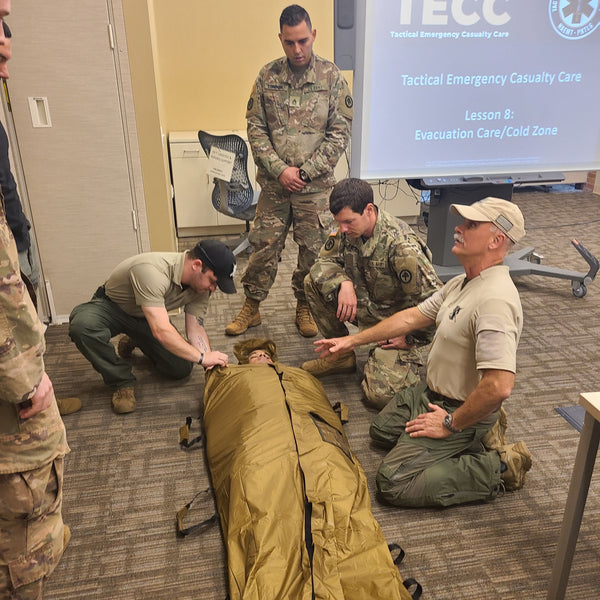
Whole blood at the point of injury didn't originate in civilian EMS. It came out of military combat casualty care, part of a two-hundred-fifty-year pattern of pushing real treatment as close to the point of wounding as possible, from Larrey's flying ambulance to Letterman's evacuation chain to the modern combat system that deliberately pushed damage-control resuscitation, whole blood, and TCCC interventions farther forward toward the point of injury. Whole blood at the front isn't new; what's modern is the systematic reintroduction and logistical support behind it. What came with that innovation, in military doctrine, was hypothermia prevention treated as inseparable from hemorrhage control from the start. Civilian EMS imported the headline capability. A fair amount of what made it work in the first place got left on the truck.
Pursuing high-acuity capability is a reasonable instinct. Whole blood isn't the first time a system has funded the advanced piece of an import before it finished funding the basic piece underneath it, and it probably won't be the last.
And to be fair, nobody's cutting a ribbon over a chemical hot pack. A whole blood program gets a press release, a grant, a photo of the cooler going onto the truck. A hypothermia kit is a line item nobody announces, because there's no ribbon to cut for keeping a patient warm. This isn't a knock on the people running blood programs, just a plain description of what gets institutional attention and what doesn't. The diamond doesn't care which vertex is more photogenic.
What this actually argues for
None of this is a case against whole blood. The case for moving blood products closer to patients in hemorrhagic shock is compelling enough that systems continue to build these programs, and whole blood offers an operationally attractive way to do it. The argument is narrower and more specific: carrying blood is not the same as having solved the problem blood was meant to solve.
A rural system deciding whether it can sustain a blood program needs an honest answer about restock economics and expiration waste before it commits, not after. Weigh that honestly against the fact that its own distance to definitive care is exactly the scenario the product was built for. A system staging blood on a supervisor or specialty unit needs to run the actual numbers on how long that convergence takes on a typical call, and ask whether a fifteen-minute trauma-center-adjacent transport is the population that resource should be protecting first, or whether it belongs on every primary unit instead. Every program, rural or urban, needs hypothermia prevention treated as a first-line intervention. Not a courtesy blanket. It is doing real physiological work the entire time the more sophisticated resource is still in transit.
The same argument extends to calcium, and Pennsylvania is a useful place to see it in writing. Current TCCC guidance ties calcium administration to transfusion, and the national Prehospital Blood Transfusion Coalition's civilian EMS guideline recommends considering IV calcium after two units of blood products have been given, because of the citrate mechanism described above. Pennsylvania's own Statewide ALS Protocol 6095, Blood Administration, effective March 31, 2024, does not mention calcium anywhere across its four pages. It covers consent, IV access, blood product typing, infusion rates, transfusion reaction levels, and weight-based dosing for red cells, low-titer O whole blood, and plasma in real detail. Calcium isn't in it. A protocol built specifically around getting blood into a bleeding patient doesn't yet address the hypocalcemia that transfusion can worsen.
Protocols get built in stages, and this one is genuinely thorough on the piece it covers. It's exactly the pattern this piece keeps returning to. The advanced capability arrives with real infrastructure behind it, a QI process, credentialing requirements, weight-based dosing tables, transfusion reaction thresholds, and the basic piece that protects it gets left for the next revision. If a system has invested in putting blood in the field but hasn't built calcium administration, active warming, temperature monitoring, hemorrhage control, and rapid transport into the same resuscitation package, it hasn't really built a blood program. It has bought blood.
The product existing somewhere in the response area doesn't finish the job. Whole blood only finishes being a good idea once it reaches the patient fast enough, and once the basics that protect its effectiveness were never left waiting on a supervisor's vehicle in the first place.
Selected references and further reading
- Brown JB, Yazer MH, Kelly J, Spinella PC, DeMaio V, Fisher AD, Cap AP, Winckler CJ, Beltran G, Martin-Gill C, Guyette FX. Prehospital Trauma Compendium: Transfusion of Blood Products in Trauma - A Position Statement and Resource Document of NAEMSP. Prehospital Emergency Care. 2025. The source for NAEMSP's own characterization of the underlying evidence quality referenced above.
- Ditzel RM Jr, Anderson JL, Eisenhart WJ, et al. A review of transfusion- and trauma-induced hypocalcemia: Is it time to change the lethal triad to the lethal diamond? Journal of Trauma and Acute Care Surgery. 2020;88(3):434-439.
- Deployed Medicine. Committee on Tactical Combat Casualty Care guidelines on hemorrhagic shock, hypothermia prevention, calcium administration, and blood product resuscitation.
- Levy MJ, Schaefer RM, O'Byrne H, Krohmer JR, Bank EA, Holcomb JB. Prehospital blood transfusion coalition clinical practice guideline for civilian emergency medical services. Trauma Surgery & Acute Care Open. 2025;10(3):e001931. The peer-reviewed source for the calcium-after-two-units recommendation referenced above.
- Seamon MJ, Fisher CA, Gaughan J, et al. Prehospital procedures before emergency department thoracotomy: "scoop and run" saves lives. Journal of Trauma. 2007;63(1):113-120.
- Winter E, Hynes AM, Shultz K, Holena DN, Malhotra NR, Cannon JW. Association of Police Transport With Survival Among Patients With Penetrating Trauma in Philadelphia, Pennsylvania. JAMA Network Open. 2021;4(1):e2034868. doi:10.1001/jamanetworkopen.2020.34868.
- Crombie N, et al. Resuscitation With Blood Products in Patients With Trauma-Related Hemorrhagic Shock Receiving Prehospital Care (RePHILL). Lancet Haematology. 2022. The randomized UK trial finding prehospital red cells plus plasma were not superior to saline for the trial's primary composite outcome.
- Young PP, Wood D, Holcomb JB, Jenkins DH, Levy MJ. Scaling of prehospital blood: A model describing impact on U.S. blood donors, distribution and cost. Transfusion. 2026. doi:10.1111/trf.70325. The source for the roughly $540 million annual cost estimate for scaling low-titer whole blood to 50 percent of U.S. EMS stations, versus approximately $47 million for liquid plasma providing comparable national readiness. The same analysis notes only about 1 percent of U.S. EMS agencies currently carry blood products of any kind.
- Saeg F, Berry CL, Tubby B, LaRock L, Casos SR, Behm R. Implementing a whole blood pilot program in a rural trauma system: A feasibility, utilization, and cost analysis. Journal of Trauma and Acute Care Surgery. 2026. doi:10.1097/TA.0000000000005019. The rural Level I trauma system pilot cited above, supplying one weekly LTOWB unit to its helicopter program with 7.2 percent waste over the study year and no statistically significant difference in monthly cost versus prior component therapy, despite the authors' own summary describing the program as cost-neutral.
- Pennsylvania Department of Health, Bureau of Emergency Medical Services. Statewide ALS Protocol 6095, Blood Administration. Effective March 31, 2024.
- Nisingizwe MP, et al. Effect of unmanned aerial vehicle (drone) delivery on blood product delivery time and wastage in Rwanda: a retrospective, cross-sectional study and time series analysis. Lancet Global Health. 2022. The source for the roughly 41-minute median delivery time and the 67 percent reduction in blood product expiration.
- Zipline-Rwanda and Ministry of Health, in collaboration with the Wharton School, University of Pennsylvania. Analysis of Zipline drone blood delivery and in-hospital maternal mortality from postpartum hemorrhage in Rwanda. 2023. Reported an approximately 51 percent reduction in in-hospital PPH mortality at drone-served facilities; a separate 2025 Ghana-based study reported a comparable 56 percent reduction. Both are observational comparisons, not randomized evidence.
Field Notes content is written by active practitioners and reviewed for accuracy at the time of publication. Medical protocols, clinical guidelines, and agency standards evolve. Always verify against your current local protocols and medical director guidance before applying anything in the field. If content has been updated since original publication, changes will be noted within the article.