What Private-Sector Responders Should Expect When a Major International Event Comes to Their City

A field note from twenty-seven years on the job, written for the responders and trained citizens who will be in and around Philadelphia for FIFA 2026.
I have worked large events for most of my career. Marathons, parades, championship games, festivals where the city's population briefly doubles. The medicine is mostly the same as any other day. Someone falls. Someone overheats. Someone has a panic attack in a crowd. Someone goes down with a cardiac event in front of fifty thousand strangers. What changes at a major event is not the medicine. It is everything around the medicine.
Philadelphia will host FIFA 2026 matches at Lincoln Financial Field and a Fan Festival at Lemon Hill in Fairmount Park. For a stretch of weeks this summer, the city will operate at a different scale than anything most of us have seen. If you are a private-sector responder, an off-duty professional, a trained citizen, or someone who simply lives or works inside one of the affected zones, there are things worth understanding now rather than the morning of.
This is not a command piece. I am not telling anyone how to run an event. I am telling you what twenty-seven years of running calls at events of various sizes has taught me about the day-to-day reality, and what changes when the event is bigger than anything your city has hosted in a generation.
The crowd is not the patient population you trained on
Most responders learned their craft in their normal environment. A street, a home, a shop floor, a school. At a major international event, the patient population shifts in ways that matter clinically.
You will see a higher percentage of patients who do not speak English. You will see patients on medications you have never heard of, prescribed under naming conventions that do not match what you carry. You will see patients with travel-related conditions, dehydration that started days before they arrived, jet lag stacked on alcohol stacked on heat. You will see psychiatric presentations from people far from their support systems. You will see chronic conditions that were managed at home and are now off the rails because someone forgot a prescription on a kitchen counter four time zones away.
The clinical answer is not exotic. The volume and the texture are. Plan for it.
Language access is harder than it looks
Look at the match schedule before each game day and learn which countries are sending teams and traveling fan bases. That tells you what languages you are most likely to encounter on a given afternoon. Knowing that you will be working a Mexico match versus a Germany match versus a Japan match changes which translation tools and quick-reference cards you should have ready.
Translation apps help, and they also fail in ways that matter. The apps can have trouble auto-detecting the source language when ambient noise is high. They can mistranslate words that carry multiple meanings, in directions that are not obvious to either party.
Years ago I worked an accident scene with a Turkish-speaking patient. I tried to tell him "the tow truck is coming." Google Translate rendered it as "Çekici geliyor," which is correct on the surface. The Turkish word çekici, however, is both the noun for tow truck and the adjective for appealing or attractive. The patient reverse-translated what appeared on his screen, what he saw back was "It seems appealing." He looked at me strangely. I had no idea why until later. The same translator that helped me speak to him had told him I was flirting with him at a car accident.
The lesson is not to stop using translation apps. It is to verify. Round-trip the phrase if you can. Watch the patient's face. If something looks off, restart and try a simpler sentence. Have a few key medical phrases pre-translated and saved offline so you are not relying on a network for the most important questions.
International soccer fans are not American sports fans
This is the part of FIFA 2026 that most US responders are underprepared for, and I want to spend real space on it because the gap matters.
International soccer fan behavior is different from anything we routinely see in American sports venues. It is not worse. It is different. Most of what looks unusual to a US-trained responder or steward is not hooliganism. It is the normal way matches are experienced in most of the world.
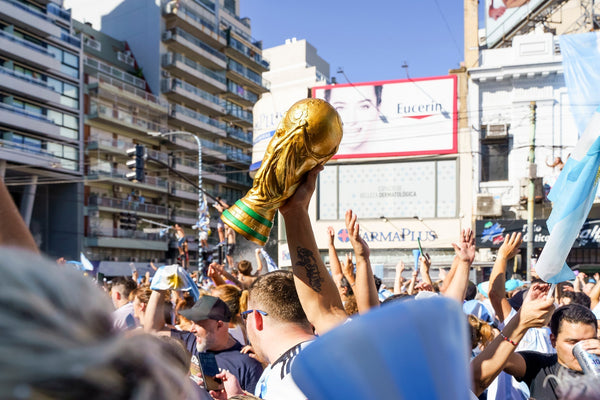
Fans stand for the entire match, not just at key moments. They surge forward in coordinated movement when the team attacks. They sing in unison for ninety minutes. Drum sections, capo-led chants, choreographed jumping where entire sections move as one body. Pyrotechnics and smoke devices are common at supporter sections in many leagues, and while they are prohibited at FIFA matches, expect them anyway. Drinking culture varies sharply by nation, and some traveling fan bases will arrive at the venue having pre-loaded for hours. Physical contact, including aggressive embracing of strangers after a goal, is part of the experience and is not a warning sign of a fight.
None of that is dangerous in itself. The danger is what happens when that pattern of behavior meets a building that was not built for it.
The buildings were designed for a different sport
After the 1989 Hillsborough disaster, in which 97 Liverpool supporters were crushed against a perimeter fence at an FA Cup semifinal, British football and then most of Europe undertook a generational redesign of stadium safety. The Taylor Report mandated all-seater stadiums in the top divisions, the abolition of perimeter fencing in front of supporter sections, segregated entry and exit routes for opposing fans, dedicated supporter sections with engineered barriers, wider radial circulation to prevent crush points, and stewarding philosophies built around managing dynamic, standing, surging crowds rather than seated audiences. Stadiums in much of South America, Asia, and parts of Africa have evolved along similar lines, often with their own local triggering events and their own engineered responses.
The buildings host an event that they were specifically designed to host safely.
US stadiums were not designed for that crowd. Lincoln Financial Field, like every NFL stadium, was designed for football. The seats are the safety system. They are individually assigned, anchored, and oriented toward a slow-pulse egress where tens of thousands of mostly seated, mostly sober adults leave on a predictable timeline. Concessions, restrooms, and circulation are scaled for that flow. Stewarding is built around enforcing assigned seating, not managing supporter-section dynamics.
When a different crowd uses that same building in a different way, the building's safety assumptions do not all hold.
This is not a warning that something will go wrong. It is the reason responders should be ready for injury patterns we do not normally see. Crush injuries at chokepoints. Trampling injuries during goal celebrations. Falls from people standing on seats not designed to be stood on. Heat illness compounded by continuous standing and dense packing in sections that were ventilated for seated occupancy. Alcohol-related collapses concentrated in tighter clusters than US venues are used to managing. Smoke inhalation from pyrotechnics in spaces with no protocol for them.
If you will be working medical at the stadium, in any capacity, walk the venue before the event. Identify the chokepoints. Know where the sections are that have been allocated to traveling supporters. Know your extraction routes from those sections, not just from the seating bowl in general. Talk to your team about who handles a goal-celebration injury cluster and how. The minute after a goal is its own clinical environment.
The Fan Festival and the bars are their own venues
Lemon Hill is a different problem. A fan festival is a stadium without walls. There are no assigned seats, no fixed capacity in the way an arena has, no ticketed entry to throttle flow. There is sun, alcohol, food trucks, terrain, and tens of thousands of people watching the match on screens. The injury pattern shifts again.
At a fanfest, expect heat illness as the dominant clinical category. Expect dehydration. Expect alcohol-related collapses spread across a wide area, which means longer extraction times and more reliance on whoever is closest. Expect pediatric heat cases because families will bring children. Expect ankle and lower-extremity injuries on uneven terrain. Expect fights that are not really fights, and fights that are. Expect lost children. Expect the entire cluster of presentations that comes with a stationary mass-gathering venue, except concentrated into the ninety minutes of a match plus the hour either side.
There is one Lemon Hill challenge worth flagging on its own: knowing where you actually are. The park is large, the terrain rolls, and a street address is not how anyone navigates it. When you call for help or hand a location to the next responder, "near the food trucks" or "by the screen" will not be enough at scale. Use landmarks. Use cardinal directions from a known fixed point. Consider an app like what3words, which divides the world into three-meter squares and assigns each one a unique three-word identifier. Pulling up a what3words location and giving a dispatcher three words is faster and more accurate than describing your position in a crowded field. Have it installed before the event, not during it.
The bars are their own problem and the one most underestimated. A neighborhood sports bar built for forty regulars will pack two hundred fans on a match day. The HVAC was not designed for that. The egress was not designed for that. The bathrooms certainly were not. If you live above one, work in one, or respond to one, recognize that on match days the building is operating well outside its design envelope. The medical calls will reflect that. Heat, intoxication, falls, and the occasional medical event in an environment where extraction is genuinely difficult.
Communications will fail before everything else
This is a constant at large events and it surprises responders every time. When you put a hundred thousand people inside a few square miles, the cell network saturates. Calls drop. Texts queue. Data slows to nothing. The towers that work fine on a normal Tuesday are simply outnumbered.
Plan for this. Have a backup communications plan with your team that does not depend on the cell network. Know which radio frequencies are in use if you carry a radio, even informally as part of an event team. Pre-load any reference material, translation phrases, maps, or contact lists onto your phone so they work without a signal. Identify where the nearest hardline phone is at any venue you will be working. If you need to send a message, sometimes a text will go through when a call will not, because texts retry in the background. Sometimes that does not work either.
The point is to assume your phone may become a flashlight and a notebook for stretches of the day, and to build your plan around that assumption rather than be surprised by it.
What to do with this if you are a private-sector responder
If you respond as part of a home agency, your agency will give you the operational picture. This piece is not a substitute for that briefing. What I want you carrying into the event is the texture of what is different.
Train your eye for crush dynamics. The seconds before a serious crowd injury are visible if you know what to look for. Sudden density changes. Loss of independent movement. People being lifted off their feet by the crowd around them. The crowd surging in a direction that has no exit. If you see those patterns, the response is not inside your normal patient-care training. It is environmental. Get out, get others out, and get the dynamic broken before you start treating people.
Carry more water than you think you need, both for yourself and for patients. Heat cases are the volume call of every summer event I have ever worked, and at this scale they will be the dominant call type.
Refresh your stop-the-bleed and basic life support skills now, not the week of. The single best preparation any responder can do for an event of this scale is to get the fundamentals so deeply rehearsed that you can perform them while distracted, while tired, while standing in the middle of a crowd that is not paying attention to you.
What to do with this if you are a trained citizen
The same fundamentals apply, with one addition. Know your scope and stay inside it. A bystander with stop-the-bleed training and a tourniquet in their bag is one of the most valuable people on the scene of a real injury. A bystander trying to run an incident is in the way. The line is clear in training and easy to forget in the moment.
If you live or work inside an affected zone, plan your routes now, identify the calm exits from your normal venues, and tell the people you are with what you would do if something went wrong. Most of preparedness is conversations had in advance.
I write this from twenty-seven years of paramedic work and from running a training company in this city. Penn Tactical Solutions does not deploy. Our instructors do, through their home agencies. What we do is help the people who will be in those uniforms, and the citizens who will be standing next to them, get ready for what the day actually looks like.
The day is coming. Use the time.
Field Notes content is written by active practitioners and reviewed for accuracy at the time of publication. Medical protocols, clinical guidelines, and agency standards evolve. Always verify against your current local protocols and medical director guidance before applying anything in the field. If content has been updated since original publication, changes will be noted within the article.